Private foundation grants are some of the most reliable and generous sources of funding available. But how do you go about locating them? In this post, we'll provide step-by-step guidance on how to find private foundation grants quickly and effectively.

TOPIC
AUDIENCE
Are you looking to fuel your nonprofit’s mission with impactful funding? Private foundation grants could be the key to unlocking the resources you need to take your work to the next level.
In this article, we’ll dive into the world of private foundation grants, explore their benefits, and show you how to find and secure these valuable resources quickly and efficiently.
Key takeaways include:
Let’s go!
Note: There are over 15,000+ private grants for nonprofits in the United States. Find your next grant opportunity using Instrumentl's free grant database.
Private foundation grants are charitable contributions made by private organizations, usually funded by affluent individuals or families.
Private foundation grants are financial awards offered by private entities, often funded by a single individual, family, or corporation. These grants are a crucial source of funding for nonprofits, playing a key role in supporting various activities and initiatives.
Private foundations set their own grant criteria and select recipients based on how well the proposed project aligns with their objectives. To apply for these grants, organizations must meet certain qualifications and demonstrate the need for funding.
Private foundation grants are versatile and can be used to fund a variety of needs, including:
For example, a foundation might only support education initiatives in rural communities or health programs targeting specific diseases.
Because of this, nonprofits must conduct thorough research to ensure their mission aligns closely with the foundation’s priorities and they are capable of delivering measurable impact within the foundation’s defined focus areas.
Private foundation grants come in all shapes and sizes and support a wide range of causes.
Let’s look at a few examples.
The Ford Foundation is undoubtedly one of the larger, better-known private foundations in the United States. This foundation works to build a world where everyone has the power to shape their lives.

While most of their grants are invite-only, there are two opportunities that the Ford Foundation advertises on their website: JustFilms, and the New York City Good Neighbor Committee.
The Richard King Mellon Foundation funds programs and projects with “bold ideas to advance prosperity in Southwestern Pennsylvania.”
The foundation’s focus areas include conservation, economic development, economic mobility, health and well-being, and organizational effectiveness.
The Richard King Mellon Foundation welcomes competitive proposals via a competitive application process.

Based in Harrisburg, Pennsylvania, this family foundation focuses their grantmaking in central and eastern Pennsylvania.
The Stabler Foundation is smaller in size, and still requires applicants to hand-deliver hard copies of their grant proposals for the selection committee to review.

MileOne Automotive’s philanthropic program, MileOneCares, is committed to creating impactful partnerships with organizations who are focused on access to transportation and strengthening communities.

This is a great example of a corporate foundation who offers grant funding through a competitive application process.
Private foundation grants offer unique advantages that set them apart from other types of funding. These benefits can be especially valuable for nonprofits seeking more flexible, long-term support.
Unlike government grants, which often come with rigid criteria and regulations, private foundations have the freedom to support a wide array of projects and programs. This means they can fund innovative or unconventional initiatives that might not fit into the strict guidelines of government funding.
Whether your nonprofit is testing a new approach, launching a pilot program, or pursuing a creative solution to a problem, private foundations are more likely to provide the funding needed to turn your ideas into reality.
Another key benefit of private foundations is the opportunity to build personal relationships with foundation staff.
Private foundations often prioritize establishing strong, personal connections with the organizations they fund, which can open doors to additional resources and guidance.
By fostering trust and rapport with foundation staff, your nonprofit can gain access to insights about upcoming grant opportunities, shifts in funding priorities, and other important information that can give you a competitive edge in securing future funding.
Private foundations tend to invest in organizations they trust and have a positive history with, making it more likely that they will continue to support your work over time.
By building strong, long-term relationships with private foundations, your organization can turn one-time grants into ongoing sources of support, ensuring a stable financial future.
This can lead to more sustainable funding streams, allowing your nonprofit to plan and grow with greater confidence.
How to Find Private Foundation Grants in 5 Steps

Instrumentl makes the process of discovering private foundation grants easier by offering the most extensive database of active funding opportunities in the United States.
In this section, we’ll walk you through a simple five-step process to finding foundation grants using Instrumentl.
Ready to dive in and discover the right private foundation grants for your nonprofit? Here’s how to get started.
Step 1: Set Up Your Nonprofit Within Instrumentl
To begin finding the best grant opportunities, the first step is to set up your nonprofit within Instrumentl. This setup process is crucial as it ensures that the platform can accurately match your organization with relevant grants that are tailored to your needs.
Simply navigate to the Instrumentl website and click “Try 14 days Free” and fill out the sign up form. No credit card required!
Voila! You’ve got 14 days to try Instrumentl for free. Now, let’s create a new project so you can start finding your grants.
To get started, select the ‘+ Project’ button at the top left of your screen.

On the first page of the setup process, you’ll provide some basic details about your nonprofit, such as your location. You have the flexibility to choose an entire state, narrow it down to specific counties within that state, or even select a global operation if your nonprofit works internationally.

Additionally, you’ll enter your organization’s fiscal year, allowing Instrumentl to align grant deadlines with your annual schedule, ensuring that you don’t miss out on key opportunities.
In the next section, you’ll begin creating a project. Think of a project like a “saved search.”
You can title your project anything you want.
For example: If you’re searching for funding for before and after school programming, you might title it “Before/After School.”
Next, you’ll want to select Matches & Tracking, because that ensures that the platform will provide you with both a grant tracker and good-fit funding opportunity matches.
Choosing the Tracking only option is best if you already have grants, and you just want to track and manage them in Instrumentl.

In the last section, you’re going to be asked to specify the following information:

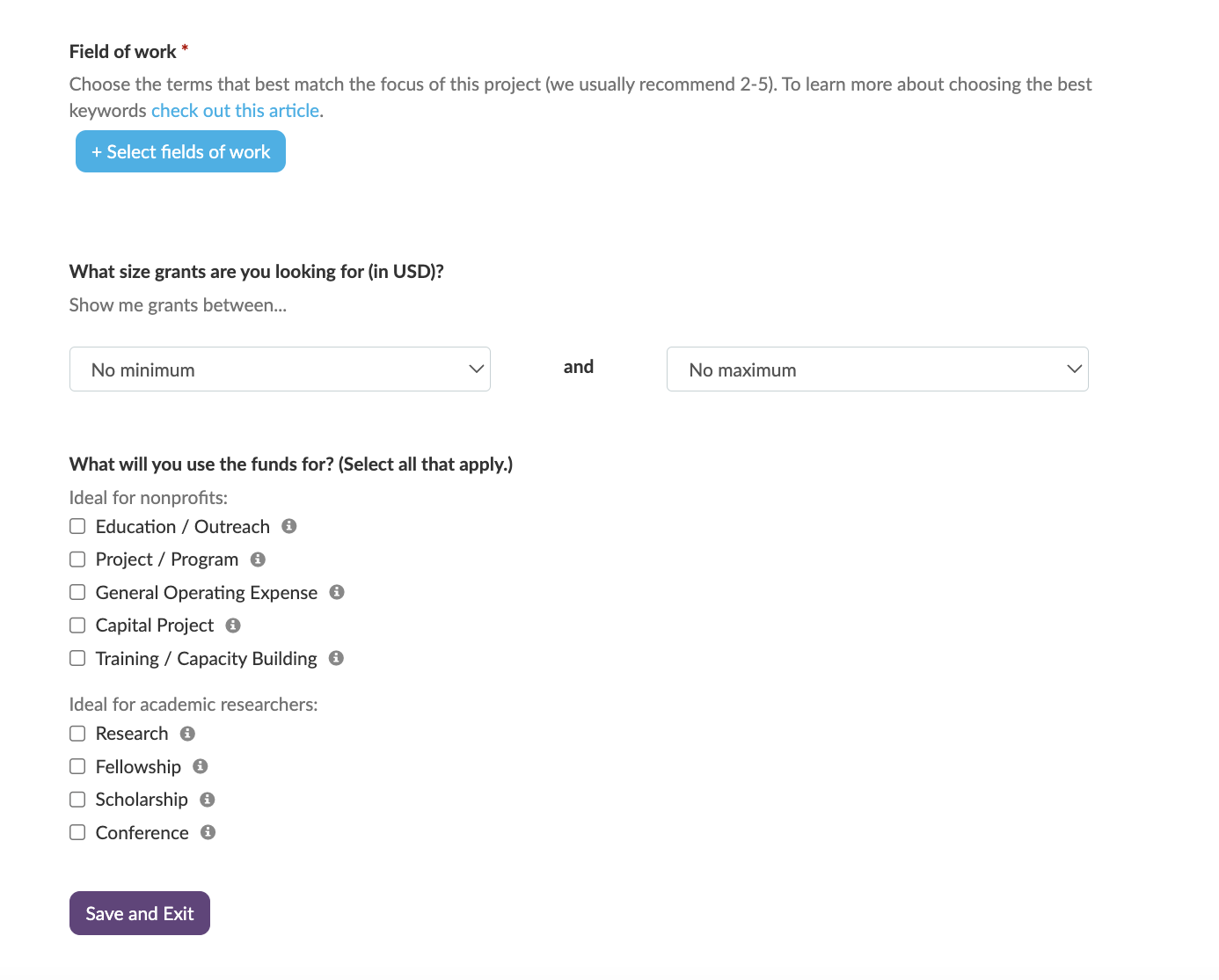
Pro Tip: Select 2-3 fields of work so that you have a wide enough scope of relevant grants.
When you’re searching for private foundation grants with Instrumentl, you don’t have to do it on your own. You can invite up to 9 team members to collaborate on your search efforts with you.

Once you finish following these few steps, Instrumentl will display all of your good-fit funding matches for you to review.
Easy peasy!

Step 2: Narrow Your Grant Search to Only Private Foundations
When you start reviewing your matches in Instrumentl, the layout will feel familiar to an email inbox.
On the left side, you’ll see a list of all your matches:
On the right side, you can see more detail on any specific match by clicking on it. Check out the example:

To focus specifically on private foundation grants, use the filters to select “Private” under the “Filter” dropdown tab. This will refine your results, showing only the private foundation grants that match your criteria.

Step 3: Prioritize Your Grant Opportunities
Once you have your list of top-matched opportunities, it’s time to dive deeper into each potential private grant. By clicking on a grant profile, you can quickly access essential details through the “Funding Opportunity” and “Funder 990 Report” tabs.
This tab offers a snapshot of the grant, including its focus area, type of support, and priority funding areas. This section helps you quickly assess whether the grant aligns with your nonprofit’s objectives.

The Funder 990 Report tab provides a summary of key data from the foundation’s 990 filings with the IRS.
This includes insights such as:

Utilizing these features on Instrumentl gives you a comprehensive understanding of each grant opportunity, ensuring that you pursue only those that best align with your nonprofit’s mission and strategic goals before you begin the application process.
Step 4: Save the Grants That You Want to Pursue Further
After thoroughly reviewing your grant matches, it’s time to save the ones that stand out as strong contenders. Saving these grants allows you to easily revisit them later in your Grant Tracker, where you can keep track of which opportunities you’ve decided to pursue.

To save a grant, simply click the prominent red “SAVE” button at the bottom of the screen. A pop-up window will appear where you can jot down any notes or thoughts you want to remember when you revisit the grant later.
Instrumentl also offers the ability to organize your saved grants by marking them as “Researching”. This feature helps you segment your saved opportunities based on where they stand in your process, making it easier to manage and prioritize your next steps.

Step 5: Store Saved Grants in Your Tracker for Future Reference
The Instrumentl Grant Tracker is an indispensable tool for managing and organizing your saved grants.
Acting as your personal database, the Grant Tracker keeps all your selected opportunities in one central location, making it easy to access, update, and monitor the progress of each grant application.

As you move through the application process, you can easily update the status of each grant in your Tracker. Simply click on the grant and you’ll find a “Status” dropdown menu. Here you can select the current stage of your application, such as “Researching,” “Planned”, or “Submitted”.
This feature ensures you always have real-time updates on your grant activities, helping you stay organized and on top of your application process.
With the Instrumentl Grant Tracker, managing your private grant opportunities becomes a streamlined, efficient, and organized experience, allowing you to focus on securing your nonprofit's funding.
5 Common Private Foundation Grants FAQs
Navigating the world of private foundation grants can be complex, but understanding the basics can significantly enhance your grant-seeking success.
Here are five common questions that grant professionals often ask about this type of grant, along with clear and practical answers.
Private foundations offer a diverse range of grants designed to fund a variety of projects and initiatives. The type and size of these grants depend largely on the foundation’s mission and focus areas.
For example, some foundations might prioritize education, while others may focus on environmental conservation or healthcare.
Grant amounts vary widely, from a few thousand dollars to multi-million dollar awards. Understanding the foundation’s specific purpose and funding priorities is key to identifying the right grants for your nonprofit.
Applying for a private foundation grant typically involves several steps; the exact process can vary by foundation. Generally, you’ll need to:
When evaluating which private foundation grants to pursue, consider the following key factors:
Selecting the right grants requires careful consideration to ensure they align with both your needs and the foundation’s priorities.
The timeline for receiving a private foundation grant can vary greatly. On average, you can expect to wait at least three months from the time you submit your application to when you hear back. However, some grants, especially those that are highly competitive or involve significant amounts of funding, can take up to a year—or longer.
Planning your application process with these timelines in mind is essential for maintaining a steady flow of funding.
Private foundation grant funds are typically versatile and can be used for a wide range of activities, including research, community programs, educational initiatives, and more.
The specific uses of the funds will be outlined in the grant agreement with the foundation, but private foundation grants often come with fewer restrictions than other types of funding.
This flexibility allows you to allocate resources where they are most needed to achieve your project’s goals.
Wrapping Up
The search for private foundation grants doesn’t have to be a daunting, time-consuming task. With the right tools, like Instrumentl, you can transform a traditionally overwhelming process into a streamlined, efficient strategy that maximizes your grant-seeking efforts.
Instrumentl emperors nonprofits to quickly identify and apply for the most relevant private foundation grants, saving you valuable time and increasing your chances of success.
Ready to elevate your grant strategy this year? Start your 14-day free trial with Instrumentl today, and take the first step toward securing more funding and driving greater impact for your organization.
Private foundation grants are funding opportunities provided by non-governmental, nonprofit organizations. They support a wide range of projects, including research, education, and community development.
To find private foundation grants quickly, you can use specialized grant databases, attend networking events, or consult with organizations that compile grant opportunities.
Common eligibility criteria include being a registered nonprofit, having a clear mission that aligns with the foundation’s goals, and demonstrating a well-thought-out project plan.
To write a strong proposal, outline your project’s goals, provide evidence of its need, detail the budget requirements, and explain how your project aligns with the foundation’s objectives.
Avoid submitting incomplete applications, failing to research the foundation’s priorities, and not following the specific instructions provided for the grant application process.
Table of contents

