Discover seven best practices for managing your nonprofit’s finances and maintaining strong financial health. From tangible tips to expert insights and tried-and-true strategies, this article provides essential guidance to help your organization avoid costly mistakes and continue serving your community effectively. Let’s ensure your nonprofit thrives!

TOPIC
AUDIENCE
Just because you work at a nonprofit doesn’t mean financial management isn’t important.
In fact, if you want to keep serving your community and enacting positive change, maintaining strong financial health is critical.
In this article, we are going to share seven best practices for managing your nonprofit’s finances. We’ll walk you through tangible tips, expert insights, and tried and true strategies to help keep your organization from making costly mistakes.
Let’s get started.
While it’s true that you’re not in the business of making a profit, financial management is just as important for nonprofits as it is for organizations in the for-profit sector.
It would be impossible to fulfill your mission if you didn’t have the funds to do so—and that starts with a strong and healthy financial base.
Here are a few things that make nonprofit financial management unique:
There’s a lot that goes into nonprofit financial management, which is why we’re here to share some top best practices with you. Keep reading!
The following seven steps should give you a solid plan to manage your nonprofit’s finances effectively so that you can keep advancing your mission for years to come.
One of the most fundamental parts of nonprofit financial management is long-term planning.

Laying out your major financial goals and objectives you hope to achieve over the next three to five years will provide your team with a clear roadmap for financial success.
We understand that taking the time to strategize financial plans over the long term can be challenging. Afterall, there are probably plenty of pressing things in your day-to-day operations that will try to take priority. But we promise that engaging in long-term planning will help set your nonprofit up for success and sustainability.
Here are some tips for how to develop an effective long-term financial plan for your nonprofit:
Your long-term financial plan should provide a roadmap for growth by setting clear objectives, identifying resources, and aligning everyone’s efforts to the overarching mission.
This planning also shows your donors, partners, and grant funders that your nonprofit has carefully planned out its goals and how to achieve them.
If you’re not sure where to start, check out this helpful Financial Management Self-Assessment Tool from the Nonprofit Association of Oregon. You should be able to use it to identify gaps in your plan and what things need to be prioritized.
It is important that your nonprofit has clear, documented policies and procedures that reflect strong internal controls.
Here’s a great quote from Propel Nonprofits on why financial policies are so important:
“Financial policies clarify the roles, authority, and responsibilities for essential financial management activities and decisions. In the absence of an adopted policy, staff and Board members are likely to operate under a set of assumptions that may or may not be accurate and productive."
What kinds of policies you should have in place will depend on your specific organization. However, here’s a list of some of the most commonly needed ones:
Ultimately, it’s important to have policies and procedures that outline who on your team has the authority to make regular financial decisions and how.
If your organization is new, you might need to develop these policies from scratch. More established nonprofits should regularly review and reassess what they already have documented to identify if any changes need to be made.
Pro Tip: Your team may also want to review a series of practices and controls issued by the Financial Accounting Standards Board (FASB) and the Government Accounting Standards Board (GASB), known as the General Accepted Accounting Principles (GAAP). Abiding by GAAP ensures an organization is following appropriate policies, rules, and regulations and that financial reports are accurate and consistent.
There are many tools and solutions out there that can make managing your organization’s finances more streamlined and effective.
For example, your nonprofit could consider investing in:
Some smaller nonprofits might only have a few funders and donors, so using tools like Excel or Google Sheets might work for a time. However, as your organization grows, investing in proper software that’s designed specifically for financial management will be necessary.
For example, Instrumentl’s grant management software streamlines the entire grant lifecycle from start to finish. Within it, you can:
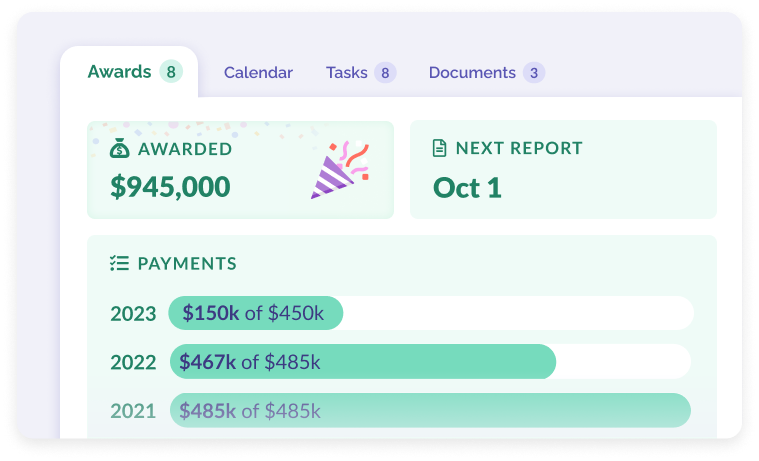
Instead of manually inputting information into an Excel spreadsheet and then having to update it regularly, Instrumentl organizes all of your grants-related information for you and then keeps it synched in real time.
If you’re not currently an Instrumentl user, you can sign up for a 14-day trial.
Budgeting can be one of the most difficult challenges you face as a nonprofit professional.
For years, there’s been a misconception in the nonprofit industry that nonprofits should operate with a “zero-based budget” since they aren’t out to make a profit. However, this couldn’t be further from the truth.
As Kate Barr from the Nonprofit Financial Commons explains:
“We’ve unfortunately been conditioned with a nonprofit starvation or need-based mindset…That is why it’s doubly important to start changing that narrative, and that starts with how you communicate the (very justifiable) reasons for why your budget does not come out to zero. A surplus builds the flex and freedom to be more creative and responsive in your programming.”
In order to plan effectively, your organization needs to have a budget in place that carefully captures your incoming revenue and outgoing expenses.
Here are some tips to keep in mind when developing your budget:

This collaborative planning can give nuanced insight into how your different departments spend their budgets and what their financial needs are. This information can also inform fundraising goals and priorities in the future.
As Don Needs from the Jitasa Group explains,
“As you start thinking through your budgeting, you definitely want to involve all key stakeholders within the process. So, that includes not only your board members, but other folks on your team in different departments to make sure everybody kind of has a say in a collective input on the direction of where your organization is going.”
Remember that your board also needs to approve the budget, so starting early will also ensure they have time to make any necessary changes.
Here are some helpful nonprofit budgeting resources you can check out as well:
An organized accounting system is essential to running a successful nonprofit organization and adhering to best practices in nonprofit financial management.
This means keeping detailed track of:
You should keep both physical copies of these records and digital copies using cloud-based storage applications. With cloud-based access, teams can collaborate seamlessly and easily pull reports when needed.
Pro Tip: With digital storage, make sure you have a back-up plan. This could include having your files synced to a separate file server so that if your files accidentally get deleted you can restore them with ease.
Arnold King, Senior Grant Writer at Black Women in Blockchain shared this with us when asked what top signs indicate that a nonprofit is grant ready and competitive:
“First of all, their finances have to be in the best shape possible. Funders look at financial statements first. If a grantor finds their finances are in the best shape possible and it fits what they're looking for, the funder will go further.”
Although financial statements are not always requested from a funder, you never want to find yourself in a situation where you can’t find the reports you need.
Having organized statements and reports allows you to easily demonstrate your financial responsibility to your nonprofit’s key stakeholders. You should also consider creating a policy on how and where you will track your statements and reports to ensure you are in compliance with any federal, state, or local documentation requirements.
Nonprofits rely on donations to survive, and these gifts come in all shapes and sizes.
From a one-time physical check to a recurring gift to an in-kind donation, reconciling gifts as soon as possible will ensure the funds are earmarked and allocated properly.
For example, planned gifts allow donors to make their charitable gift through an estate plan, trust, or will. This means the donor will stipulate how their assets are distributed to the nonprofit organization upon his or her death. These are usually larger donations, but the setup can be complicated and may require outside consultation.
You will want to also reconcile restricted versus unrestricted gifts. Restricted gifts have specific instructions as to how the funds should be used, while unrestricted gifts are made without any specific conditions or stipulations.
Planning for regular audits will ensure your nonprofit is both efficient in its spending and compliant with any grant funding or 501(c)3 requirements.

Whether it is an internal audit or an audit from a government funding agency, you should prepare for them at least four to eight weeks in advance by gathering the following:
Review the IRS’s guides for nonprofits for more information on federal requirements.
You can better prepare for external audits by conducting your own audits internally. These audits usually fall into two different categories:
To conduct internal audits you can take the following steps:
If you are working with federal, state, or local government agencies, they may have separate compliance audits to ensure your nonprofit organization is adhering to their specific regulations and requirements.
Planning regular audits not only ensures your organization’s compliance, but also supports continuous improvement in your operations and mission fulfillment. Nonprofits may consider hiring a certified public accountant (CPA) or an audit firm experienced in nonprofit compliance to complete these tasks.
Effective financial management is crucial for the success and sustainability of your organization. These top seven best practices should help your nonprofit stay in compliance and run smoothly now and in the future.
And if you haven’t already, make sure to sign up for a 14-day free trial of Instrumentl to easily track your grants, organize your budgets, and manage your reporting deadlines.
Table of contents

