Explore various budget types and real-world examples and gain insights from seasoned grant professionals. Plus, access a downloadable budget template.

TOPIC
AUDIENCE
It doesn’t matter if you’re applying for a government, corporation, or foundation grant, a well-crafted budget will make or break your proposal.
We interviewed over a dozen grant consultants and professionals to understand what grant budgets need to pass the sniff test with funders and convince them to open up checkbooks.
In this guide, we are going to share examples of effective grant budgets and highlight advice from seasoned grant writers. We’ll cover:
Let’s dive in!
A grant budget is one of the most important parts of your grant proposal.
A grant budget is a detailed financial plan that outlines the estimated expenses of your proposed project or program for which you’re seeking funding. If the budget isn’t carefully crafted or doesn’t fall in line with the requirements of the funder, it could cause you to lose the award.

In general, the steps to creating a grant budget, include identifying all your potential expenses, delineating between direct and indirect costs, and giving yourself some buffer for unexpected costs.

Likewise, always budget time for yourself to share the budget with your board and finance team so everyone’s on the same page, and you can make changes if need be before you get down to the wire with submission deadlines.
In many cases, funders will skip to your budget first before reading anything else in your proposal to make sure it meets their criteria, including:
For example, if your budget is too high, a funder might immediately pass you over. If your budget is too low, you could be setting yourself up for failure.
The NIH Central Resource for Grants and Funding Information, a leader in grant funding, further emphasizes the importance of properly estimating your budget:
“Significant over- or under-estimating suggests you may not understand the scope of the work.” - The NIH Central Resource for Grants and Funding Information
Even if you have the perfect idea for a new project, you will still lose out on funding if your grant budget isn’t feasible and in line with the funder’s priorities.

Santa Clara County Office of Education covers several more helpful tips for building grant proposal budgets in their webinar (starting at 3:27).
There are several types of grant budgets you might use in a grant proposal.
Below we’ve outlined five of the most common budgets and explained when and why they might be used:
Grant budgets will look different depending on what they’re for. But each budget will include direct costs, those expenses related to the project or program you’re funding, as well as indirect costs that go along with running an organization. Depending on the type of grant you win, the award will cover only direct costs, or, if a general operating grant, it may cover much more.

To make it more concrete, let's look at 3 examples of grant budgets. We'll show an operating budget, a project budget, and a capital budget.
Operating budgets are easier to develop because you can estimate the amounts based on the day-to-day costs in your organizational budget from the prior year.
Some common operational expenses could include the following:
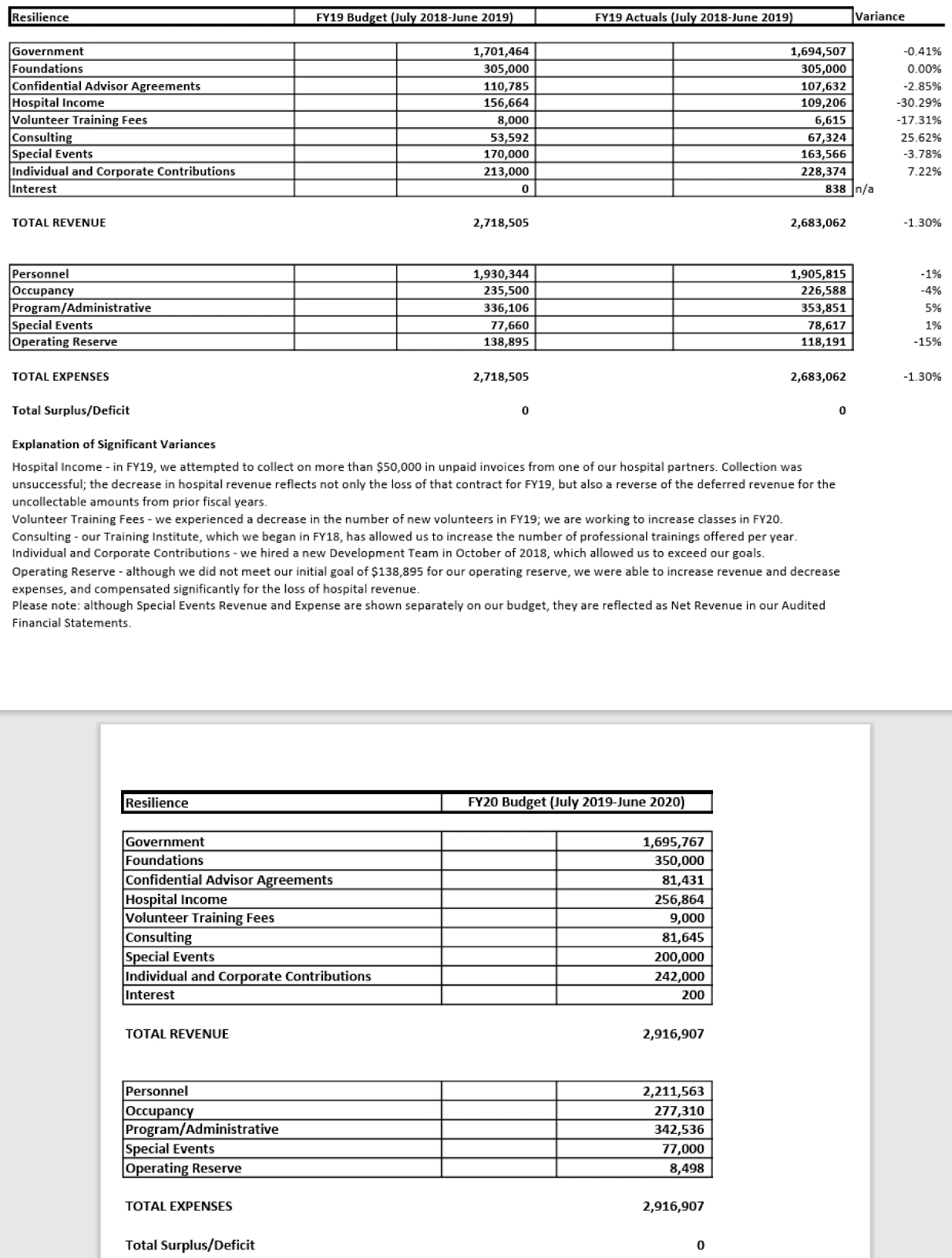
As an example, the operating budget below details the total expenses for a General Operating Grant for $40,000 for a Chicago-area violence prevention and intervention nonprofit. This example even includes explanations of variances between the budget and actual amounts:
Project budgets should outline your overall spending plan for your entire project, from successfully executing it to evaluating its impact and sustainability.
Line items usually found in a project plan include:
The Council of New Jersey Grantmakers has a project budget sample for a Community Education Initiative that lays out each budgetary requirement clearly and accurately for the funder:

Capital grants are usually for large-scale items like construction, renovations, or equipment.
Budgetary items include:
Western Kentucky University had numerous improvements they wanted to complete on their campus. They created a capital budget that detailed the capital expenditures over a multi-year life of a possible grant. The entire capital budget can be found here, and a sample of their budgetary items is shown below and can be used as a budget template:

Downloadable Grant Budget Templates
There are many resources to assist you with creating your own budget after you’ve considered all of the direct and indirect costs of your project.
For example, one of the helpful grant budget examples comes from the Substance Abuse and Mental Health Services Administration (SAMHSA). You can download this example here and repurpose it to use as your own budget template.
This sheet provides a great sample of staffing and personnel needs for a proposed project. It also walks the reader through a budget justification and includes matching grant funds.

You can also use Instrumentl's Grant Budget Template sample from the U.S. General Services Administration, which is a simple budget in Google Sheets that can be tailored to your specific budget line items.

This is another helpful example that you can repurpose with your own budgetary information.
Expert Advice on Building Your Grant Budget
There’s a lot of advice you’ll hear through the grape vine regrading grant budgets. To help pick out the signal from the noise, we interviewed several seasoned grant professionals. Here’s what they had to share.
All experts agree that details matter when compiling your budget. If the details aren’t clear or don’t add up, a funder will see through your numbers.
Elizabeth Morgan Burrows, JD, principal of Burrows Consulting, stresses that you should have a detailed budget that lists each of your expected expenditures for the entirety of your project. That way, the funder has a clear understanding that your nonprofit has the means and manpower to complete the proposed project.

Some general line items you will want to prioritize include:
Each line item in your budget should align with your overall narrative. If there is an activity explained in your narrative that requires funding, it must be a line item in your budget.
Lyndel King, Chair, Board of Overseers at Hill Museum & Manuscript Library, stresses that you need to "make sure that the item is somehow accounted for in the narrative. Everything in the budget should be able to be tied back to the project narrative.”
A clear budget will instil confidence. Anything less could arouse suspicion or doubt, costing you the award.

With that said, Sarah Lange, a grant consultant, advises grant teams not to undersell themselves either.
“Funders want to see reasonable costs, but please don’t fall prey to pressure to keep overhead low! Your program costs what it costs, and your staff deserves a living wage!”
Earlier, we discussed the importance of staying realistic and feasible. Jacob B. Chase from Chase Consulting Solutions, agrees.
He's quick to remind his clients that a realistic budget is a winning budget. It shows that your "and organization has thoroughly considered the financial aspects of the project."

Finally, your budget needs to establish a clear connection between the numbers and your goals.
A funder will more than likely skip over your proposal if your budget doesn’t meet the needs of the intended audience.
CEO of Chase Consulting Solutions, Jacob B. Chase, shares,
“Demonstrate a clear connection between the budget and the project goals outlined in the proposal. Funders want to see that resources are allocated to activities that directly contribute to the project's success.”
Rachel Grusin, Project Coordinator for the Legal Aid Society of San Diego, further explains that nonprofits can't expect to slide in a line item without a clear explanation for why it belongs.

Ready To Submit Your Grant Budget?
It should be clear by now that your grant budget can make or break your chances of winning funding. The examples, insights, and expert advice in this guide should provide you with the resources you need to craft an effective and compelling budget in your next proposal.
For even more helpful advice, check out these 24 tips for stronger grant proposals.
A grant budget is a detailed financial plan that outlines how grant funds will be allocated to support a project or program. It ensures transparency and helps funders understand how their contribution will be used.
Key components of a grant budget include direct costs, indirect costs, personnel expenses, travel costs, supplies, and any other expenses necessary for the project. Each category should be clearly defined and justified.
Indirect costs are calculated as a percentage of the total direct costs. This percentage is often predetermined by the funding organization or institution and covers expenses like administrative support, utilities, and facilities maintenance.
A budget narrative is crucial as it explains the rationale behind each expense in the grant budget. It provides context and justifies the necessity of the costs, making it easier for funders to approve the budget.
Adjustments to a grant budget are typically allowed but must be approved by the funding organization. It’s important to communicate changes and ensure they align with the grant’s objectives and guidelines.
Table of contents

