The Grant Maturity Model: What 500+ Grant Professionals Told Us Separates Strategic Teams From Scrappy Ones
Instrumentl surveyed 582 grant professionals to build the first maturity model for grant work: seven dimensions, three stages — from Scrappy to Strategic. One in eight organizations is Strategic. Compared with Scrappy teams, Strategic teams report half the missed deadlines, walk away from half as many grants, and lose half as much of the week to manual work. This post walks through each dimension, where the field sits, and the specific practices peers say helped them level up.
TOPIC
Grant Strategy
AUDIENCE
Grant Prospecting
Post-Award Grant Management
Grant Management
Key Takeaways
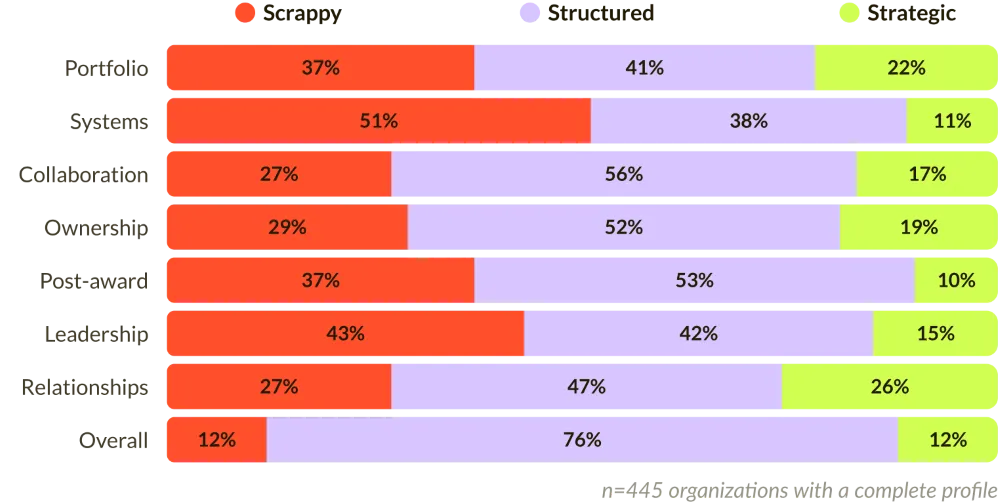
Most grant teams are 1-2 practices short of Strategic. 12% of organizations are Scrappy, 76% are Structured, and 12% are Strategic. Structured teams already build strong relationships with their funders and collaborators. What separates them from Strategic is a short list of practices — a named owner on every grant, spending reviewed before the report is due, and the grant lead in the room when programs are planned.
Strategic teams get results. They report half the errors and delays vs. Scrappy teams, walk away from half as many grants, lose half as much of the week to manual work, and win more of what they apply for.
Maturity is not size. Organizations under $500K land in the three stages at nearly the same rates as organizations over $15M.
Systems is the weakest dimension in the field. 51% of organizations are Scrappy on their system of record. The median grant team runs seven tools and three workarounds, and only 38% say a colleague could find where their pipeline or portfolio stands without asking.
Post-award is where the fewest teams are Strategic. Only 9% have defined thresholds that mark when they're spending is off track. 45% catch errors because someone happens to notice.
No one gets into grant work because they’re passionate about data entry. They get into grant work to make sure the programs they care about get funded. But the administrative work — moving information between spreadsheets, scouring email for answers and approvals — takes up a lot of the week.
Grant professionals tell us they’d like to spend less time on “admin” and more time on strategy.
So in October 2026 we set out to measure what strategic grant work actually looks like.
We asked 582 grant professionals how their teams operate — what they pursue, where the work lives, who owns it, what leadership sees. We sorted organizations into three stages (Scrappy, Structured, and Strategic) across seven dimensions (Portfolio, Systems, Collaboration, Ownership, Post-award, Leadership, Relationships).
We’re calling it the Grant Maturity Model.
How to Use This Report
This report is designed as a benchmark and a playbook for grants managers, development leaders, finance teams, and executive directors.
Use it to:
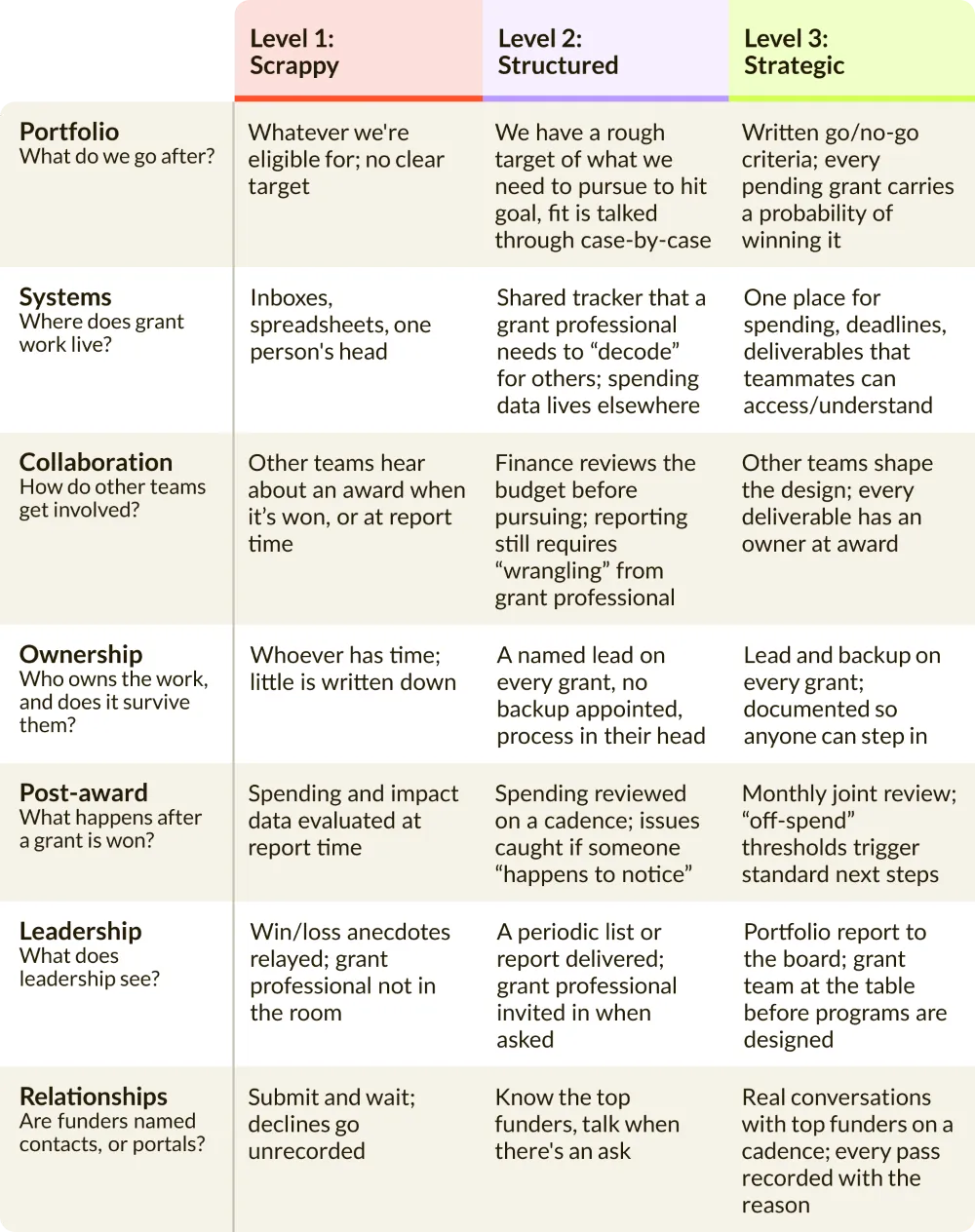
Find your stage. Each of the seven dimensions comes with a three-stage table written in the first person.
Find the one dimension that’s holding you back. 76% of organizations are Structured overall. Find where you’re still Scrappy. An organization that is Strategic on Portfolio and Relationships but Scrappy on Post-award and Systems has very specific next steps.
Borrow what worked for someone else. Every dimension ends with advice from Strategic-stage respondents, in their own words. Pick one practice to implement this week.
The Maturity Model
The model measures a grant team on seven dimensions:
Portfolio. What do we go after, and what do we decline?
Systems. Where does grant work live?
Collaboration. How do other teams get involved?
Ownership. Who owns the work, and does it survive them?
Post-award. What happens after a grant is won?
Leadership. What does leadership see?
Relationships. Are funders contacts, or portals?
Scrappy teams get grants done. Applications go out and reports are sent because one or two people make it happen. Everything they know lives in their inbox and their head. Ask how much is left on a grant and the answer is “give me a day.”
Structured teams keep grants running. There’s a shared tracker, a calendar, a rhythm. They collaborate well with program staff and finance, but they’re still on the hook for anything that goes wrong. The process works because they’re vigilant.
Strategic teams shape what comes next. Finance and program staff treat grant money as something they help win and steward. Nobody has to ask where a grant stands, because the whole organization can see it. And when the organization decides what to prioritize next, grant professionals are part of that decision.
Systems and Leadership are the only dimensions where more organizations are Scrappy than any other stage. Post-award has the fewest Strategic organizations: one in ten.
For a breakdown of the practices that define each dimension, download the full report.
Strategic Advice from Participants
Portfolio
“Prioritize by sorting funders into one of four lanes: Now (aligned and ready); Next (relationship building); Not mine (not aligned); Never (stop pursuing).”
“Coming to a clear understanding of our go/no-go criteria and process, writing it down, using it for each opportunity, and celebrating when it’s working (including when we’ve decided NOT to go for a grant!).”
“Keeping track of grants that are NOT a fit for our organization, just like we keep track of grants that are a fit, so we are not researching grants that are not applicable for us over and over again.”
Systems
“Having all pending grants and reports due in one place that everyone has access to, broken up by program.”
“Created a more organized folder structure in the shared drive, a grants calendar with due dates and reporting deadlines, and finally a master grant tracking doc.”
“Created a resource manual with answers, of varying lengths, about general topic areas to use as boilerplate responses that can be modified easily. Updating semi-annually for up-to-date stats.”
Collaboration
“Having a grant kick-off call with all relevant staff where we walk through key info: grant deliverables, reporting, invoicing, file storage, key contacts.”
“Each grant starts with the NOFO or RFA. From there I build a file structure in our shared drive. Then I build a detailed spreadsheet that has each required step, built from the NOFO. This spreadsheet allows us to assign tasks to staff. It’s our workspace for building the grant. This has been transformational for our team.”
“Grant memos after a grant is awarded to clearly outline who is responsible for deliverables and reporting.”
Ownership
“I created an SOP so that if I left my role, the development team would know the status of each grant and how to move forward.”
“Assigning a staff member as a lead person if awarded, so that all awards are not managed by one person.”
“I created an E.D. playbook which my Board Chair can access should anything unexpected happen to me.”
Post-award
“This year we implemented a monthly check-in between grants leadership and finance leadership. We do a rundown of new awards, what’s pending, and any potential issues. This ensures that no one is surprised when new money arrives.”
“Setting up at least a quarterly meeting for all grants, creating a form for these meetings with assignments, due dates, budget and actual spending, and follow-up notes.”
“I learned to run actuals-to-date in the new software and started pushing for leadership to use that info to set a realistic budget at the start of the year, and then manage using that data.”
Leadership
“Sharing an executive director’s report that includes the pipeline, fit, status, and how we are tracking to spending and grant reporting.”
“Meeting quarterly with executive leadership to strategize projects that need funding and review current and upcoming grant proposals and reports.”
“Weekly phone calls with leadership (CEO). Even if it’s just when he’s driving to a meeting, we touch base about open grants, reports that are due, what I am working on, and timelines. It also allows me uninterrupted time to ask questions I need to complete my reports and grants.”
Relationships
“Contact funders first to make sure project ideas are aligned to the focus areas before writing the whole grant, especially for small foundations, because they do not give feedback on why grants were declined.”
“I began a new process for prospect email outreach, which I track using a spreadsheet that shows the foundations I have reached out to, secured meetings with, and summaries of the outcomes with next steps. I think this will help me get more invitations to submit and stop or minimize submitting proposals cold, which have a much lower chance of getting funded.”
“We have a master foundation prospects list where we drop notes, map connections and rate potential. This helps us progress from research to a decision whether to pursue or not and allows us to keep track of which prospects don’t look promising and why.”
Why the Strategic Habits Matter
Strategic teams get results — reporting both higher work satisfaction and work performance than their Scrappy peers.
Half as many grants walked away from. 95% of Scrappy teams walked away from, delayed, or downsized at least one grant last year for operational reasons; 59% of Strategic teams did.
Half as much of the week lost to manual work. Scrappy teams estimate 38% of their time goes to manual or repetitive tasks. Strategic teams estimate 20%.
More likely to feel recognized. Asked whether “the complexity of my work is invisible to my leadership,” 80% of Scrappy grant professionals agree, compared with 27% of Strategic ones.
Bigger awards, more often. Strategic teams say 47% of their active awards are government grants or worth $100K or more; for Scrappy teams it’s 33%. Win rate moves in the same direction: 39% for Scrappy, 48% for Strategic.
A Personal Maturity Model for Grant Professionals
The organizational model describes the system.
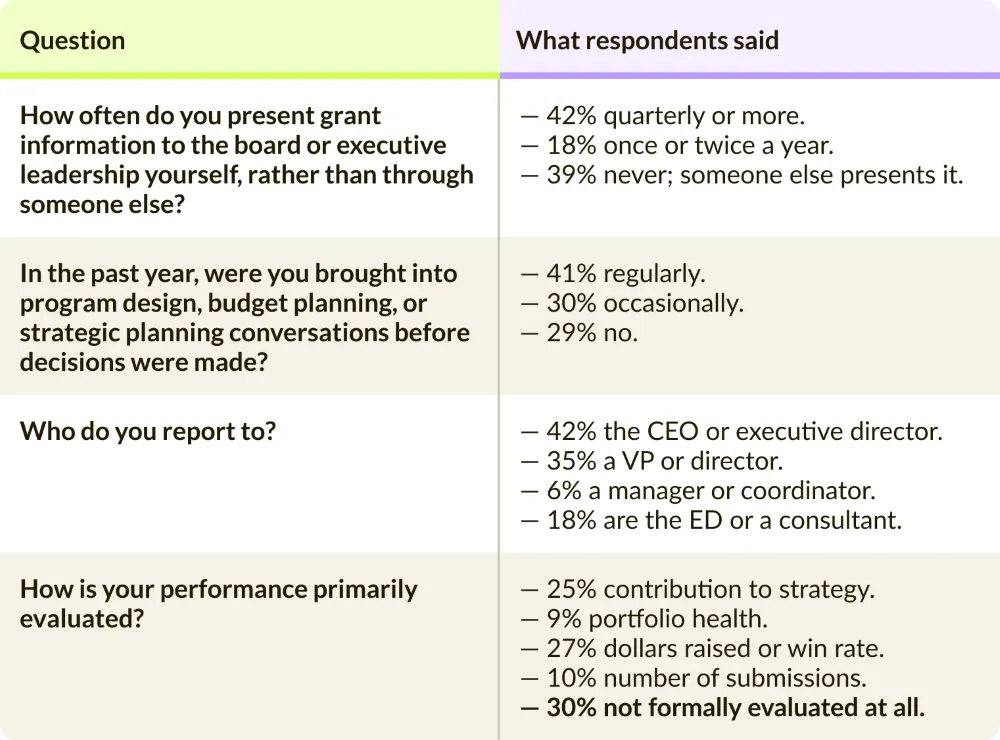
These personal practices describe a grant professional’s work: who presents grant results, who they report to, whether they’re consulted before programs are designed, and how they’re evaluated.
Grant professionals operate more strategically on the whole than their organizations — 27% Scrappy, 44% Structured, 29% Strategic.
But three findings stand out.
Seniority does not determine stage. Experience helps, but does not drastically change the story. 25% of grant professionals with 2-5 years of experience score as Strategic. This jumps only to 34% amongst grant professionals with 11-20 years of experience.
Influence shrinks as the organization grows. At organizations under $500K, 8% of grant professionals hold a Scrappy seat and 33% hold a Strategic one. At organizations over $50M, it’s 45% Scrappy and 8% Strategic. The grant professionals with the most complex portfolios are the least likely to present their own work, the least likely to be consulted on program design, and the most likely to be evaluated on submission counts.
Access creates more access. Among grant professionals who present to leadership quarterly, 60% are also consulted regularly on program design. Among those who never present, 19% are — and 47% are never consulted at all. 39% of grant professionals never present their work themselves. One room gets you into the others.
Leveling Up: The First Move for Every Stage
If you’re Scrappy: get it on the record. The single most important practice is a documented process someone else could step into — only 19% of organizations have one. You need one folder, document, or tool that says, for each active grant: who owns it, who backs them up, what’s due, what’s spent, and where the deliverables are. Then make it the only place that information lives. That one record changes three dimensions at once: it’s your Systems record, your proof of Ownership, and the thing your collaborators reference when a report comes due.
If you’re Structured: Prioritize your post-award systems. For many organizations, pre-award deadlines are shared and current; post-award spending and deliverables are not. The move is to hold post-award to the same standard: your spenddown as visible as your pipeline, and every report, site visit, and deliverable assigned a named owner and an internal deadline on the day of award, set at a kickoff.
If you’re Strategic: fix the one dimension that lags. Most Strategic organizations have one. In this sample, it’s most often Post-award or Systems.
Whatever stage you’re in: get in the room. Request fifteen minutes on the next leadership or board agenda and bring three things: your pipeline, the forecast weighted by likelihood of award, and the list of grants you chose not to pursue and why. That’s the report Strategic organizations already give their boards. Once leadership has seen it, the other invitations tend to follow.
Grant Work, Leveled Up
The model measures what happens when grant work moves upstream. One in eight organizations has done it. They are not bigger. They are not better funded. They have written criteria for what to pursue, one place where everything lives, named owners on every deliverable, finance and programs in the room from the start, thresholds that catch spending before the report does, a board that sees the whole portfolio, and funders they actually talk to.
Three in four organizations are one or two dimensions away. Instrumentl is built to close that gap — one place for the whole grant lifecycle, so you spend less time keeping the grant team running and more time deciding where it’s headed.
Discover — Find funders that fit. Instrumentl analyzes 450k+ funder profiles and 36k+ human-vetted opportunities against your programs, priorities, and eligibility.
Apply — Write great proposals faster. Instrumentl pulls funder portal information into one interface and helps you draft from the answers that already won.
Manage — Simplify post-award. Instrumentl syncs with your accounting software and tracks spenddown in real time, so the numbers are ready when the report is due.
Collaborate — Know where every grant stands. One home for deadlines, tasks, and documents; automated reminders instead of follow-up emails; the right visibility for every role.