

August 6, 2026
The Impact Issue #121: Four ways AI fails your grant proposals
Hi! Welcome to The Impact.
In a recent Instrumentl survey, 75% of grant pros report using AI in their work, and almost the same number is worried about that. The anxiety showed up everywhere:
- 72% worry funders will penalize proposals that look AI-written
- 69% aren't sure whether what AI hands them is even accurate
- The most-requested resource was how to keep your organization's voice and data intact when using AI
The tools are everywhere; the confidence to use them well isn't.
Here's the reframe worth holding onto: most funders have no stated position on whether applicants use AI, and plenty encourage it.
Some do prohibit it, so check the guidelines. What matters to them isn't whether you used AI, it's that you can stand behind what you submit.
And you can't stand behind what you don't understand. The fake citation, the draft that fits any nonprofit — those failures aren't random. They come from a few predictable ways AI works, and once you know them, you can catch and fix them.
Today we're breaking down how to tell when AI is failing you, and how to make it write like your organization instead of a generic one.
Higher Ed Teams...Join Us Next Week!
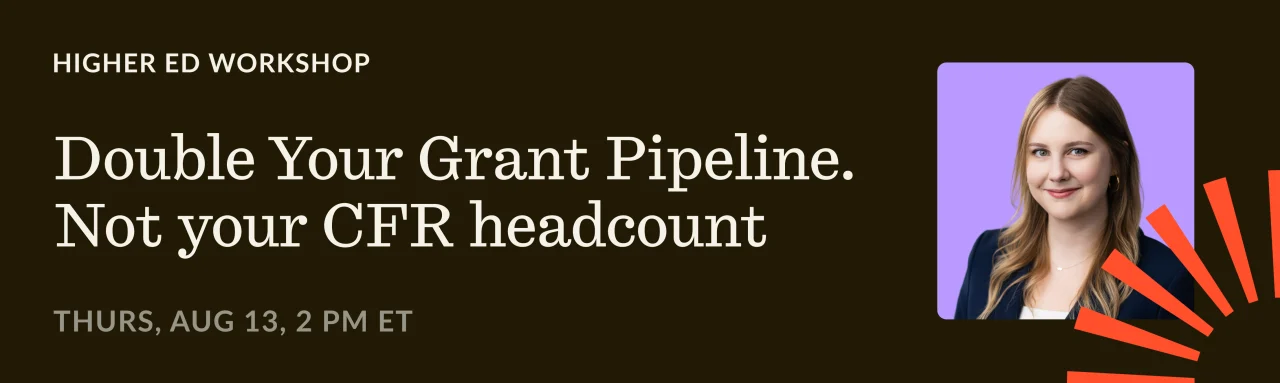
CFR teams are being asked to close the funding gap without adding headcount. Join live on August 13th to get the playbook.
Federal funding is shifting, and lean higher ed CFR teams are feeling the squeeze. At the University of St. Thomas, a 2.5-person team built momentum in a volatile funding environment and doubled their pipeline of qualified prospects.
On Thursday, August 13th at 2pm ET, Danielle Kincs, Director of Corporate and Foundation Relations at the University of St. Thomas, joins us for a hands-on workshop to share exactly how they did it.
You'll walk away with:
- The meeting structure and agenda framework to launch monthly check-ins to keep all advancement stakeholders aligned
- A checklist of campus touchpoints to turn faculty into your force multiplier, so CFR becomes the first call instead of the last resort
- A first look at new tools that let faculty prospect for funding on their own, with approvals routing every application back to your central office
Plus, benchmark yourself against how other higher ed institutions are adapting their grant research and management systems amid major federal and private funding shifts.
👉 Save your spot now - it's free!
Pitfalls and Pointers
Using AI effectively starts with knowing how it breaks.
⚠️ Pitfall: Using AI without understanding how it fails
Most grant pros already use AI to draft narratives and tighten proposals, but few can explain why it returns a citation to a federal study that doesn't exist, or a summary that fits any youth program in the country.
You can't catch a fabricated source you didn't know to check, or fix a generic narrative you don't know how to steer. Almost every bad draft traces to a few predictable behaviors.
💡Pointer: Learn the four ways AI fails, then fix each one
At our workshop last week, Fielding Jezreel broke down the four properties behind almost every bad AI output. Each has a tell, and a fix.
- It predicts, it doesn't know. By default, AI picks the next likely word, it isn't looking anything up. Ask for a stat "with a citation" and it'll invent a real-looking "GAO report" or "2023 SAMHSA study" that was never written. Fix: verify every stat and source before it goes in a proposal, and point AI to real material to draw from (web access, or your own funded proposals) instead of asking it to fill in the blank.
- Its knowledge is frozen, general, and uneven. Trained up to a point in time, it'll confidently give outdated compliance facts — ask for the de minimis indirect rate and it may still say 10%. Fix: never trust its built-in knowledge for anything current or regulatory; feed it the source. Treat generic output as a sign you haven't given it enough about your program.
- Its memory drifts. Two hours into a draft, it loops, turns generic, and drops details you set early. Fix: chunk work into focused projects, restate what matters, and when it degrades, have it summarize progress and carry that into a fresh chat.
- It does exactly what you describe, but no more. Vague prompts get generic proposals, and it aims to please, so "is my narrative good?" gets flattery. Fix: be explicit and show it a strong past narrative as a model. Instead of "is this good?", say "score this against the funder's criteria and flag the three weakest sections."
Expert Perspectives
🏆 Fielding Jezreel on Making AI Sound Like You
The most common fear about AI isn't inaccuracy, it's erasure: every draft coming back sounding like any nonprofit in the country.
Fielding's fix is a voice print: a short reference doc capturing how you writ for your organization: the personality, values, tone, and signature habits, so every draft sounds like it came from your office.
- You can build it one of two ways. If your narratives already win, feed past grants into AI and have it extract the voice print. If you're newer or founder-led, answer a guided set of questions, Fielding did her own in about 45 minutes.
- Keep facts out. Capture voice, not stats; those change.
- Put it to work. Drop it into a grant-writing project's instructions or attach it to prompts, and have AI write to it every time.
What we all fear the most is that we just get erased. A voice print is how you keep that from happening. — Fielding Jezreel, Jezreel Consulting
Open Grant Opportunities Spotlight
Target Community Engagement Funds Grant — Target Foundation
Grant Amount: $1,000 – $15,000
Next Deadline: September 3, 2026
Who It's For: U.S. 501(c)(3) public charities and schools, in the U.S. or its territories
The Details:
- Local community grants across four focus areas: Thriving Families (basic needs, youth development), Vibrant Neighborhoods, Emerging Creative & Culture, and Economic Opportunity
- Max 10 applications per organization at any time; you can't apply for the same program in both cycles
What their past giving tells us:
- Gives nationwide (preference for home state of Minnesota)
- 19% of awards went to new grantees over the most recent 3 years
Ardmore Institute of Health Grants — Ardmore Institute of Health
Grant Amount: Unspecified
Next Deadline: LOI Invitation Request due Oct 19, 2026 (Spring 2027 cycle) | LOI due Dec 2, 2026 | Full proposal by invitation only
Who It's For: U.S. 501(c)(3) public charities and government agencies
The Details:
- Funds lifestyle medicine and whole-person care to prevent, treat, and reverse chronic disease, across three focus areas: whole-person primary care, comprehensive obesity care, and equitable care in underserved communities
- Prioritizes projects that use Full Plate Living and have multiple funding sources
What their past giving tells us:
- Median grant of $75,000 in 2024
- 41% of awards went to new grantees over the most recent three years of data
Ready to find more good-fit opportunities? Explore thousands of other grant opportunities now!
Put Reliable Sources Behind AI and Grant Work
AI is only as good as the context it's working from. Point it at the open web and it'll invent funders and surface dead opportunities.
Instrumentl's Claude connector links Claude to your account (grant matches and your active pipeline in your tracker), so the grants it pulls are current and relevant:
- Ask for a ranked shortlist of matches with deadlines in the next 90 days, prioritized by fit.
- Save grants to your pipeline without copy-paste… tell Claude to add a grant, and it pushes back into your tracker.
- Put prospecting on autopilot: on a paid Claude plan, a recurring task drops a fresh digest each Monday.
👉 Start a free trial and connect your account to Claude.
Sign up to get The Impact newsletter delivered to your inbox every week. Subscribe now!
100% Free Grant Writing Resources Straight to Your Inbox
