

August 18, 2026
The Impact Issue #122: If your 3 biggest funders walked, would you be ok?
2025's giving data makes the case for diversifying, starting with a grants culture shift at your organization
Hi! Welcome to The Impact.
By almost every headline number, 2025 was a strong year for giving. Total U.S. charitable giving reached an estimated $617.20 billion (Giving USA) — passing $600 billion for the first time ever, and up 3.0% after inflation.
So why does it feel precarious?
Because the growth is narrow. More money is coming from fewer people, which leaves more organizations quietly dependent on a small handful of funders staying happy, staying healthy, and staying interested. A record-breaking year and a fragile one can look identical from the outside.
Here’s the question worth sitting with: if your three biggest funders stopped giving tomorrow, would you be fine?
For most organizations, the honest answer is a reason to diversify — and for a grants-focused team, one of the most durable ways to do that is to stop treating grants as one person’s job and start building a grants culture.
Today we’re breaking down how.
On the subject of alignment…don't miss out!
Fewer than 1 in 5 grant professionals can quickly say how much they’ve spent on a grant.
With federal funding shifts and compliance expectations rising, funders and auditors are asking harder questions than ever, and most post-award processes simply weren’t built to answer them.
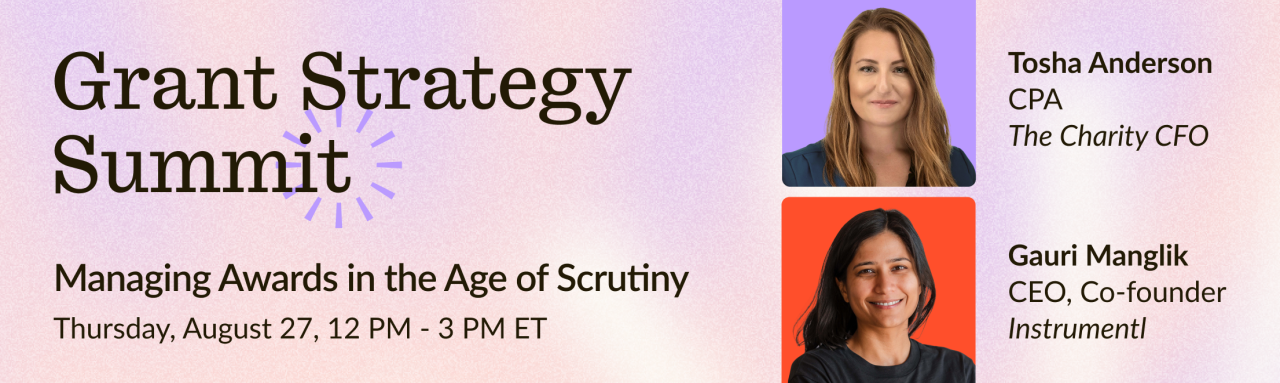
On August 27 at 12 PM ET, Instrumentl is hosting its first Grant Strategy Summit: Managing Awards in the Age of Scrutiny, a free half-day summit that brings grant professionals and finance leaders together to pressure-test your post-award process.
You'll walk away with:
- A health check for your grant finances. Keynote speaker Tosha Anderson, founder and CEO of The Charity CFO, walks through the must-have practices behind healthy grant finances in 2026, and what to fix first.
- Over-the-shoulder time with a peer. Go inside a real nonprofit’s spend-tracking process and the workflows they rebuilt.
- The enduring habits of strong grant + finance teams. The routines that keep spenddown, compliance, and funder reporting on track.
Attend live and get your post-award scorecard with a “fix first” priority guide.
👉 Save your spot now - it's free!
Pitfalls and Pointers
Diversification isn’t a fundraising buzzword. It’s the difference between a strong year and a stable one.
⚠️ Pitfall: Leaning too hard on one source of funding
Every organization has its center of gravity — the reliable government contract, the founding foundation, the two or three major donors who anchor the budget. Leaning on what works isn’t lazy, but concentration is what makes a good year fragile.
- The 2025 numbers hide the risk. Giving grew 5% — the strongest in five years — but the donor base shrank 3.6%, a decline that’s run since 2021 (Fundraising Effectiveness Project). The growth came from fewer, larger gifts, which leaves you exposed to decisions outside your control.
- The gains weren’t evenly shared. Bequests, foundations, and DAFs surged while individual giving rose just 1.4% after inflation — so where your revenue sits determined whether 2025 felt strong or tight.
Grants are one of the most powerful ways to broaden your funding mix — but only if grant-seeking is a resourced capability, not a task that lives or dies with one grant writer.
💡Pointer: Build a grants culture, not a grants department
A grants culture makes grant-seeking part of how the whole organization operates, so your pipeline doesn’t rest on a single person or funder. Three moves that travel to any size:
- Let shared priorities decide what you pursue. Agree on your top three to five priorities for the year, then use them as a filter — so a board member’s random forward gets a strategic “no” instead of 100 wasted hours.
- Make more people part of the effort. Create regular touchpoints — consultations, office hours, new-staff orientation — so colleagues across the org spot opportunities and bring funder relationships in.
- Democratize your storytelling. Train program staff, volunteers, even your front desk to capture small moments of change — so you’re never writing a narrative from scratch.
The payoff isn’t just more grants. It’s a pipeline that doesn’t collapse when one funder — or one staffer — walks away.
Expert Perspectives
🏆 DH Leonard Consulting on Escaping the “Isolated Island” of Grant Writing
For a lot of grant professionals, grant work can feel like operating from an isolated island. The grant writer works in a silo, chasing down program data, budget details, and outcome metrics under the pressure of a looming deadline -- rather than approaching it a shared, strategic effort.
The result is predictable: internal bottlenecks, writing fatigue, and missed opportunities.
In a recent piece on building a sustainable grants culture, the team at DH Leonard Consulting makes the case that the fix isn’t working harder inside the silo - it's dissolving the silo.
When grants become a team-wide effort rather than one person’s task, the daily hurdles start to resolve on their own:
- Mission creep loses its grip. Shared alignment keeps you pursuing only the opportunities that fit, which protects the team from the burnout of chasing off-mission money.
- The deadline scramble eases. When program staff understand how their data feeds competitive proposals, that information flows continuously instead of in a last-minute panic.
- Funder trust deepens. Collaborative planning produces more accurate budgets and realistic goals, which makes for smoother implementation and more confident funders after the award.
The through-line: a grants culture isn’t just a way to win more grants. It’s what makes the work sustainable.
👉 Read the full piece: How to Build a Sustainable Culture of Grants in Your Nonprofit, by Maggie Perry, DH Leonard Consulting.
Open Grant Opportunities Spotlight
Robinson Foundation Grant (Robinson Foundation)
Grant Amount: Unspecified (median grant size of $13,500)
Next Deadline: Applications open September 1 through October 15, 2026
Who It's For: U.S. 501(c)(3) public charities active more than 3 years
The Details:
- Funds a wide range of areas: children and families, education, medical assistance, poverty relief, disaster relief, animal welfare, nature and wildlife conservation, veterans’ issues, and religious and spiritual endeavors
- Supports projects and programs (not facilities or capital projects)
- Single-year funding only
What their past giving tells us:
- 50-60 grants awarded annually with giving concentrated in Tennessee but reaching most states
- 19% of awards went to new grantees over the most recent 3 years
What their past giving tells us:
TJX Foundation Grants (The TJX Foundation)
Grant Amount: Unspecified
Next Deadline: Letter of inquiry due October 31, 2026 (pre-proposal accepted on a rolling basis; full proposal by invitation only)
Who It's For: 501(c)(3) nonprofits registered at least 12 months, located within 15 miles of a TJX store, distribution center, or office
The Details:
- Funds four social impact areas: basic needs (food, clothing, shelter), education and training for at-risk youth, workforce readiness for young adults (16–24), and safety from domestic violence
- Does not fund the following: general operating, staff salaries, capital campaigns, scholarships, and schools/colleges
What their past giving tells us:
- Grants of $5,000–$10,000 are typical
Ready to find more good-fit opportunities? Explore 35,000+ active grant opportunities now!
Networking Nook
💻 The Future of Nonprofit Software in the Age of AI
August 26, 2026 | 12:00–1:00 PM Central | Virtual Webinar (Free)
A live roundtable with four nonprofit software CEOs on how they’re adapting their companies and products to the AI era, including the case for open platforms that let nonprofit data move freely, their vision for the next three to five years, and a real workflow each has unlocked for customers with AI.
Panelists: Gauri Manglik (CEO, Instrumentl), Sruti Bharat (CEO, Campground), Max Friedman (CEO, Givebutter), and Gabe Cooper (CEO, Virtuous), moderated by Ted Kriwiel (Founder, Honeystack).
To check out more recent and upcoming live events, go here.
One lean team’s proof that building a grant culture works
A 2.5-person Corporation and Foundation Relations team at the University of St. Thomas built exactly this kind of grants culture, and over five years tripled the proposals they submitted and nearly quadrupled the ones awarded. Watch the full session to see how they did it.
Part of how they scaled their grant program across campus without adding headcount was through Instrumentl.
Their CFR team creates a project for each area of the organization, surfaces best-fit opportunities proactively instead of waiting for them, and can track every deadline and report in one place.
👉 See what Instrumentl can do for your team!
Sign up to get The Impact newsletter delivered to your inbox every week. Subscribe now!
100% Free Grant Writing Resources Straight to Your Inbox
