
Pro Tip: Before you pay the list price for any subscription database, check TechSoup and your state nonprofit association. GrantStation and several others sell the same access to members for a fraction of the retail rate.
The right grant database points you at the funders you can actually win, instead of leaving you to hunt one foundation website at a time. This guide compares the 19 best grant databases for nonprofits and grant writers in 2026, what each is best for, and which free and paid options are worth your time and money.

TOPIC
AUDIENCE
The hard part is finding the right opportunities without spending your whole week buried in browser tabs, and that is exactly what a grant database is for.
The catch is that there are dozens of them: they run from free federal portals to four-figure subscriptions, and they are not interchangeable. We pulled together the 19 worth knowing in 2026, what each one does best, and which are free versus worth paying for, so you can choose a fit.
Here is what you’ll get:
A grant database is a searchable collection of funding opportunities and the funders behind them. Instead of clicking through one foundation website at a time, you filter by cause, geography, funding type, and deadline, and have a working list in minutes.
The better ones go further than a feed of open calls: they show a funder's giving history, who they have funded before, and typical award sizes, so you can tell a real fit from a long shot before you spend hours on grant applications.
Here is every database in this guide side by side. Free options are genuinely useful, and a paid database earns its keep when it saves you enough research time to land one more grant a year.
Prices reflect each provider's current public pricing as of 2026 and should be confirmed on their site before you subscribe, since grant-tool pricing changes often.
Best for: Nonprofits that want funder matching and 990 intelligence.
Cost: From $299/month (billed annually).
Trade-off: A paid platform, so the value kicks in once you are applying to grants regularly.
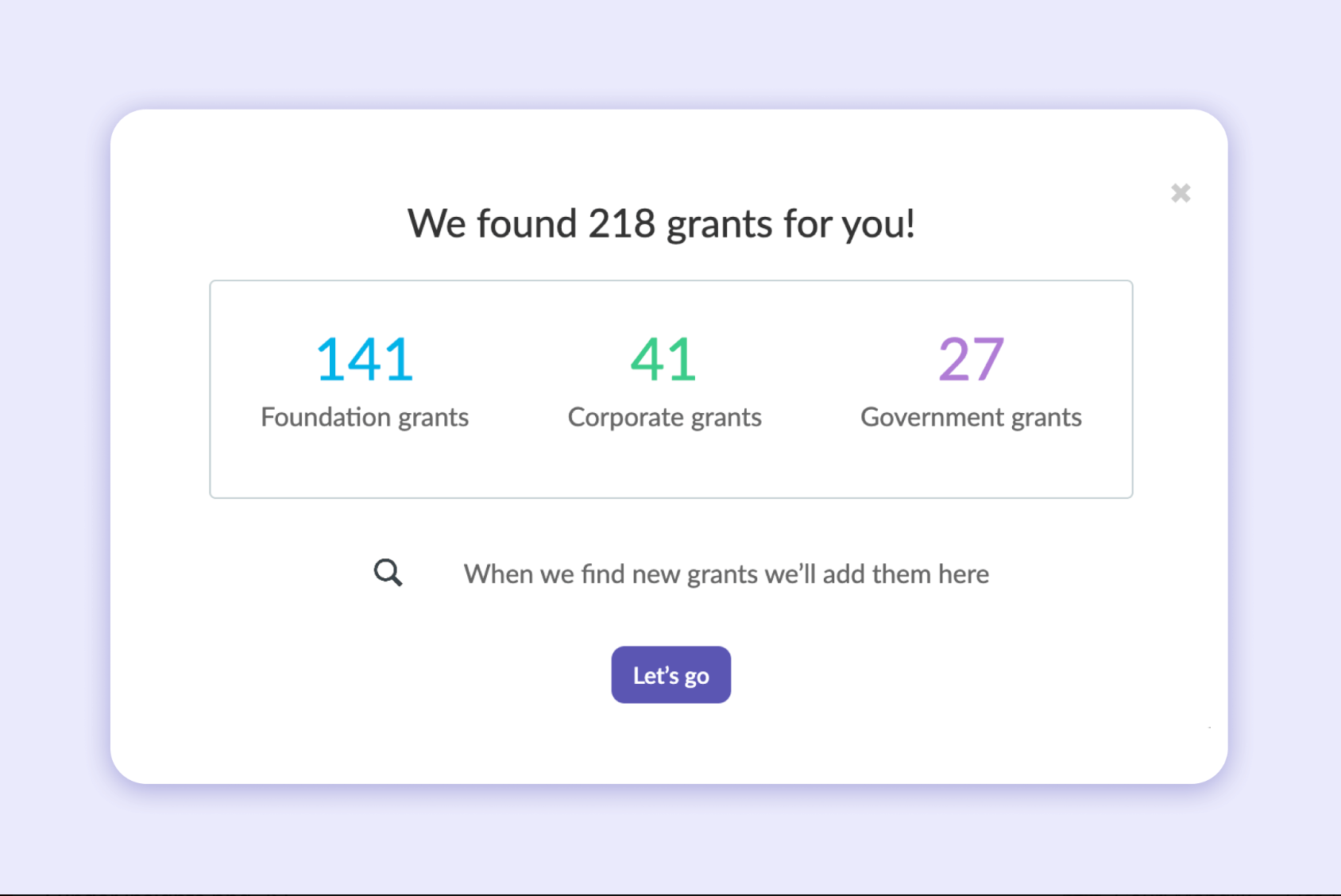
Instrumentl is the one option here built to do the whole job rather than just point you at a list, pairing funder matching and a live opportunity database with grant tracking and reporting so finding funders and managing what you win happen in the same place. Three things set it apart:
Best for: Deep foundation prospect research.
Cost: Free tier; Premium from $219/month or $1,199/year.
Trade-off: Heavy on foundations, light on federal and live RFP tracking.
Candid's Foundation Directory is the deepest well of private foundation data available, drawn from tax filings and grant records. It is the reference tool grant professionals reach for when they need to understand a foundation's giving patterns in detail, and a free tier plus public-library access make an entry point possible for small teams.
Best for: Budget-conscious small and mid-sized nonprofits.
Cost: About $199/year direct, often $95–$139 through associations or TechSoup.
Trade-off: Lighter on federal competitive intelligence like past winners and award amounts.
GrantStation is a curated database of grantmakers and opportunities aimed squarely at small and mid-sized nonprofits, with strong coverage of private, corporate, and community funders, including international sources. Its real advantage is price: list membership is modest, and it drops further through TechSoup and state nonprofit associations.
Pro Tip: Before you pay the list price for any subscription database, check TechSoup and your state nonprofit association. GrantStation and several others sell the same access to members for a fraction of the retail rate.
Best for: Browsing a broad range of grants cheaply.
Cost: Annual plan $249/year (monthly and weekly options cost more over time).
Trade-off: Listing-focused, with limited giving history or matching.
GrantWatch lists roughly 10,000 active grants across federal, state, foundation, and corporate sources, and it is built for browsing a wide range of opportunities quickly. It is affordable and easy to skim, though it focuses on listings rather than the funder intelligence that helps you decide what to actually pursue.
Best for: Finding and applying to federal grants.
Cost: Free.
Trade-off: Federal only, with a bare-bones search experience.
Grants.gov is the official portal for U.S. federal grant opportunities, and any organization chasing federal money ends up here. It is free and thorough on federal programs, and it is where you will actually submit many of those applications. The search is basic, without the advanced search filters found in paid tools, and it covers nothing beyond the federal world, but for federal funding it’s not optional.
Best for: A free stream of current RFPs.
Cost: Free.
Trade-off: A feed, not a searchable, filterable database.
Run by Candid, the Philanthropy News Digest RFP Bulletin is a free, curated feed of current requests for proposals from foundations and other funders. It won’t replace a full database, but it’s a genuinely useful no-cost way to catch active opportunities as they are posted.
Best for: University researchers and research administrators.
Cost: Institutional subscription (contact for pricing).
Trade-off: Built for academic research, not general nonprofit programs.
GrantForward lives in the research world, indexing funding from federal agencies, foundations, and other sponsors and matching it to researcher profiles. If you sit in a university research office, it is likely already on your radar; if you run a community nonprofit, it’s not built for the way you work.
Best for: Research-intensive universities and their grant offices.
Cost: Institutional subscription (contact for pricing).
Trade-off: Overkill and out of budget for most community nonprofits.
Pivot-RP, from Clarivate, is another research-funding heavyweight, pairing a large funding database with a directory of scholars to support collaboration. Like GrantForward, it is sold to institutions and priced accordingly.
Best for: Organizations with mixed research and program funding needs.
Cost: Annual subscription (tiers by category).
Trade-off: Less depth on any single funder than a specialist database.
GrantSelect offers broad coverage across disciplines, from arts and humanities to science and community programs, with email alerts for new opportunities. It sits between the academic tools and the nonprofit ones, useful for organizations that span both worlds.
Best for: Global NGOs and international development organizations.
Cost: Paid subscription (Devex Pro).
Trade-off: Little value for U.S.-only, domestically funded nonprofits.
Devex Pro Funding is the go-to for international development funding, covering bilateral and multilateral donors, foundations, and NGOs working globally. For organizations operating outside the U.S. funding system, it fills a gap the domestic databases do not touch.
Best for: Startups and small orgs wanting free search plus optional expert help.
Cost: Free search; paid add-ons and consultant marketplace.
Trade-off: A newer, thinner dataset than the established players.
OpenGrants pairs a free grant search with an optional marketplace of grant consultants, positioning itself as a more open alternative to the big subscription databases. The free tier makes it worth a look for startups and small organizations, with paid help available when you want it.
Best for: Small U.S. nonprofits on a tight budget.
Cost: Free tier; low-cost paid upgrade.
Trade-off: Limited funder intelligence and a smaller dataset.
GrantGopher is a straightforward grant search aimed at small U.S. nonprofits, with a free tier and an inexpensive paid upgrade. It will not match the depth of the premium tools, but the price is hard to argue with for an organization just getting started.
Best for: Consultants and vendors researching funders and nonprofits at scale.
Cost: Paid (contact sales).
Trade-off: Aimed at market research more than active grant seeking.
Cause IQ compiles data on nonprofits and the funders that support them, and it is used heavily by consultants, vendors, and researchers who need to analyze the sector at scale. For a grant seeker it is more of a research and list-building tool than a day-to-day opportunity feed.
Best for: Reading a funder's 990s to confirm fit.
Cost: Free.
Trade-off: Shows past giving rather than open opportunities.
ProPublica's Nonprofit Explorer puts millions of nonprofit and foundation tax filings online for free, so you can read a funder's 990 and see exactly who they have funded and how much. It is not a grant-opportunity database, but it is one of the best free ways to vet a funder before you apply.
Pro Tip: Before you spend hours on a foundation proposal, pull the funder's most recent 990 on ProPublica and check whether they fund organizations like yours, at the size you are requesting. It is the fastest free way to avoid a long-shot application.
Best for: Foundation-focused prospecting and giving analysis.
Cost: Paid (contact sales).
Trade-off: Narrower than an all-in-one platform; foundation-centric.
FoundationSearch focuses on foundation giving history and analysis, with tools to identify funders by their actual grants rather than stated priorities. It competes with Candid on foundation depth and is worth evaluating if foundation prospecting is the center of your strategy.
Best for: Health and biomedical research funding intelligence.
Cost: Free.
Trade-off: Specific to NIH-funded biomedical research.
NIH RePORTER is a free federal database of biomedical research funding, letting you search awarded NIH grants by topic, institution, and investigator. For health and medical research organizations it is both a funding-intelligence tool and a way to study who is winning in your field.
Best for: Organizations that need to receive federal funding.
Cost: Free (registration required).
Trade-off: Administrative and dense; not a browsing tool.
SAM.gov is the U.S. government's official system for entities doing business with the federal government, and registration there is required before you can receive most federal awards. It also hosts contract and assistance-listing data, making it a necessary stop for any federally funded organization.
Pro Tip: Register in SAM.gov before you need it. The process, including your unique entity ID, can take a few weeks, and a lapsed or missing registration will stop a federal award cold at the worst possible moment.
Best for: Researching who wins federal awards and at what size.
Cost: Free.
Trade-off: Historical award data, not open opportunities.
USASpending.gov is the free public record of federal spending, including grants, so you can see which organizations have won federal awards, for how much, and from which agency. Used alongside Grants.gov, it turns a list of programs into real competitive intelligence.
Best for: Local and regional, place-based funding.
Cost: Free.
Trade-off: Scattered across many sites; no single search.
Your state agencies and local community foundations run their own grant portals, and they are among the most overlooked free sources of place-based funding. Because the applicant pool is smaller and the funders care about local impact, these opportunities are often more winnable than national ones for a community-rooted organization.
Free databases are strongest on federal and public data; paid databases win on foundation depth, matching, and time saved.
For a federally focused organization, a handful of free tools cover most of what you need at no cost:
Where paid databases pull ahead is private philanthropy and speed. Foundations do not post to a central portal the way agencies do, so a database like Candid or a matching platform like Instrumentl saves the hours you would otherwise spend piecing together giving histories by hand. The honest test is time: if a paid tool helps you find and win one additional grant a year, it has paid for itself several times over.
Pro Tip: You do not have to choose one lane. A common setup is one free federal source, one free 990 lookup, and a single paid database matched to your funding mix. That combination covers public and private funding without stacking subscriptions you will not use.
If you want a starting kit, Instrumentl's free Ultimate Grant Writing Resources Collection bundles templates and guides for finding funding and winning grants in one place.
The right database depends less on which is best overall and more on how your organization is funded. A few questions can help you narrow it down:
If your answers keep pointing to matching, 990 data, and managing what you win in one place, that is where Instrumentl fits. Start a free trial and run a real search against your cause and geography to see the funders within reach today.
It depends on your funding mix. Instrumentl is the strongest all-in-one option for nonprofits that want funder matching and 990 data alongside grant management, Candid Foundation Directory is best for deep foundation research, and Grants.gov is the essential free source for federal opportunities.
For federal grants and funder 990s, free tools like Grants.gov, USASpending.gov, and ProPublica are excellent. Paid databases pull ahead on private foundation depth and on matching, which saves the research time that free tools ask you to spend yourself.
No single database covers every funder and opportunity. Federal portals don't track foundations, and most foundation-focused databases are thin on federal programs, so most teams pair one free federal source with one database that fits their mix. An all-in-one platform like Instrumentl comes closest by combining foundation data, active RFPs, and management in one place.
For budget-conscious small and mid-sized nonprofits, yes, especially at the discounted rate available through TechSoup or a state nonprofit association. It offers solid coverage of private and community funders, though it is lighter on federal competitive intelligence than the free government sources.
Costs range from free to several thousand dollars a year. Common paid options include Instrumentl from $299 per month, Candid Foundation Directory from $219 per month, GrantWatch at $249 per year, and GrantStation around $199 per year before nonprofit discounts.
Table of contents
