A SWOT analysis is a strategic planning tool. This guide explains what a nonprofit SWOT analysis is, how to conduct one, and how to analyze the findings effectively.

TOPIC
AUDIENCE
While you may not have full control over the opportunities and threats that face your nonprofit, you do have the ability to maximize your strengths and overcome your weaknesses. These are the key principles at the core of a SWOT analysis.
In this guide, we will explain what a nonprofit SWOT analysis is, how to conduct one, and how to best analyze your findings. We will also share best practices that will help you make the most out of your organization’s strategic analysis.
Let’s get started.
Before we can begin our step-by-step guide on conducting a SWOT Analysis for nonprofits, we must first go over what a SWOT Analysis is and why it can be so helpful to your organization.
A SWOT Analysis, also known as SWOT Matrix, is a planning and management technique that focuses on identifying both internal and external factors that contribute to or hinder the growth of your organization.

While for-profit companies tend to use SWOT analyses to make business decisions, nonprofits can also greatly benefit from them for strategic planning.
The questions asked during a SWOT Analysis revolve around identifying:
When conducted correctly, a SWOT Analysis provides you with the insights needed to make strategic decisions when developing specific programs or growing your organization as a whole.
Now that we have a broad understanding of what a SWOT analysis is and its benefits, let’s go over how to properly conduct one.
The first step in conducting a SWOT analysis is identifying your organization’s strengths. As we stated above, your strengths are the internal things that your organization does well.
You should begin by identifying the key things that your organization excels at and sets it apart from others. Your strengths might include:
By recognizing your strengths, you can leverage these advantages to achieve your goals more effectively.
When trying to figure out what your nonprofit’s strengths are, start by asking yourself the following questions:
Remember to be as honest as possible when answering these questions. Don’t hesitate to ask your staff, board members, or volunteers what they think your nonprofit’s strengths are.
If strengths are defined as the internal factors under your control that give you a competitive advantage, then your weaknesses are the exact opposite: they are internal factors also within your control that hinder your progress.
To properly identify your weaknesses, you need to honestly assess areas where your organization may be struggling or facing challenges. For example, some weaknesses might be:
To help uncover your own nonprofit’s weaknesses, ask yourself:
Though unpleasant, it is important to be as honest as possible when answering these questions. Remember to not be discouraged! You may be focusing on previous failures, but you are doing so with the aim of learning from your mistakes and making up for your shortcomings.
Opportunities are the external factors that nonprofits can take advantage of to further their missions.
These could include:
To identify opportunities for your nonprofit, consider these questions:
Identifying opportunities is all about research. Since you don’t know what you don’t know, you’ll need to look for answers in places you might have never considered before.
Don’t be afraid to talk to your team, donors, and even board as they might have useful insight into opportunities your organization could be taking advantage of.
Just as weaknesses are the opposite of strengths, threats are the opposite of opportunities. In other words, they refer to external factors that may pose challenges or risks to your nonprofit's mission and operations.
These may include:
To identify potential threats, ask yourself the following:
By recognizing potential threats, your nonprofit can better equip itself to face these future obstacles. You might change your fundraising strategy, shift how funds are allocated, or adapt your outreach campaigns to work around these new hurdles.
Now that we know how to conduct a nonprofit SWOT analysis, it’s time to analyze your findings.
Once all aspects of the SWOT analysis have been thoroughly examined and understood, you should be able to utilize this information to formulate smart plans for future endeavors.
Look at your current budget, business plan, and marketing strategy. Of the solutions you’ve come up with, which ones can be applied immediately? Which ones might still need more funding or staff in order to be undertaken?
Seeing what can be done right away and what might need to be worked towards will give you an idea of what you should prioritize and how you can arrange current and future resources to the benefit of your nonprofit.
When done correctly, a SWOT analysis will give you all the pieces you need to create a strong plan for both the short and long term sustainability of your nonprofit organization.
Eight SWOT Analysis Best Practices
You now should know how to conduct a SWOT analysis and how to analyze your findings. Now, it’s time to discuss eight SWOT analysis best practices that can help you maximize your results.
To get the most out of a SWOT analysis, nonprofits should tailor the process to their specific needs.
Is your nonprofit facing difficulty with advertising fundraising events? Retaining volunteers? Securing grants?
You could conduct a nonprofit SWOT analysis focused on any of these specific areas where you are currently unsatisfied with your performance.
By customizing the SWOT analysis framework to a specific context, nonprofits can gain deeper insights that are directly applicable to their decision-making processes.
While SWOT analyses could be done by just one person, it is best to engage a diverse range of stakeholders in the process.
Board members, staff members, volunteers, donors, and beneficiaries each bring a unique perspective that can contribute valuable insight.
If possible, also try to involve them in the implementation of your new strategies. This ensures that identified strategies are aligned with stakeholder expectations and priorities.
By including different voices and perspectives from within and outside the organization, nonprofits can ensure a comprehensive understanding of their strengths, weaknesses, opportunities, and threats.
When conducting a SWOT analysis, nonprofits should prioritize objectivity to ensure accurate and unbiased results. It is crucial to approach the analysis with an open mind and avoid any personal biases or preconceived notions.
This can be difficult, as we are likely to downplay what comes naturally to us and excuse away our shortcomings. Besides trying to engage your team in the process, also make sure to look at some hard data. The numbers will not lie to you, and their concrete nature will provide you with the objectivity needed to answer each question honestly.
As mentioned above, objective numbers are important. But so are anecdotal experiences.
By leveraging both quantitative and qualitative data, nonprofits can obtain a more holistic view of their current situation.
To get the most out of your SWOT analysis, you should consider both types of research when identifying your strengths, weaknesses, opportunities, and threats, and when analyzing your findings.
Prior to answering nonprofit SWOT analysis questions, make sure you have a clear understanding of your goals.
What is it that you are hoping to achieve? What would constitute a successful analysis for you? What can you do beforehand to ensure this goes as smoothly as possible?
By aligning your SWOT Analysis with your strategic goals, you can ensure that the insights gained from the analysis are both actionable and contribute to a positive impact on your organization.
To get the most out of this method, your nonprofit should regularly revisit and update its SWOT analysis to reflect changes in its internal and external environments.
Reassess your strengths and weaknesses as time passes and your nonprofit evolves. Have new staff presented you with new resources and expertises? How have unforeseeable threats—such as a pandemic—affected the way you operate?
By continuously reviewing your SWOT analysis, you can stay proactive in adapting strategies and programs to maximize opportunities and mitigate risks.
You should also effectively communicate your findings and your plans to relevant stakeholders when the SWOT analysis process is done.
If possible, create a clear and concise presentation that uses visual aids such as charts or graphs to highlight key strengths, weaknesses, opportunities, and threats.
For some communication strategy tips, check out this post on our blog.
As we have emphasized throughout this guide, conducting a SWOT analysis alone is not sufficient; nonprofits must use the insights gained from this exercise to drive positive change within their organizations.
Here are actionable steps for formulating outcomes based on your SWOT analysis:
Monitor Progress: Regularly review and monitor the progress of your strategies and action items. Use key performance indicators (KPIs) to measure success and make adjustments as needed.
Instrumentl’s SWOT Template:
If you’re ready to embark on a SWOT analysis for your nonprofit organization, we have you covered.
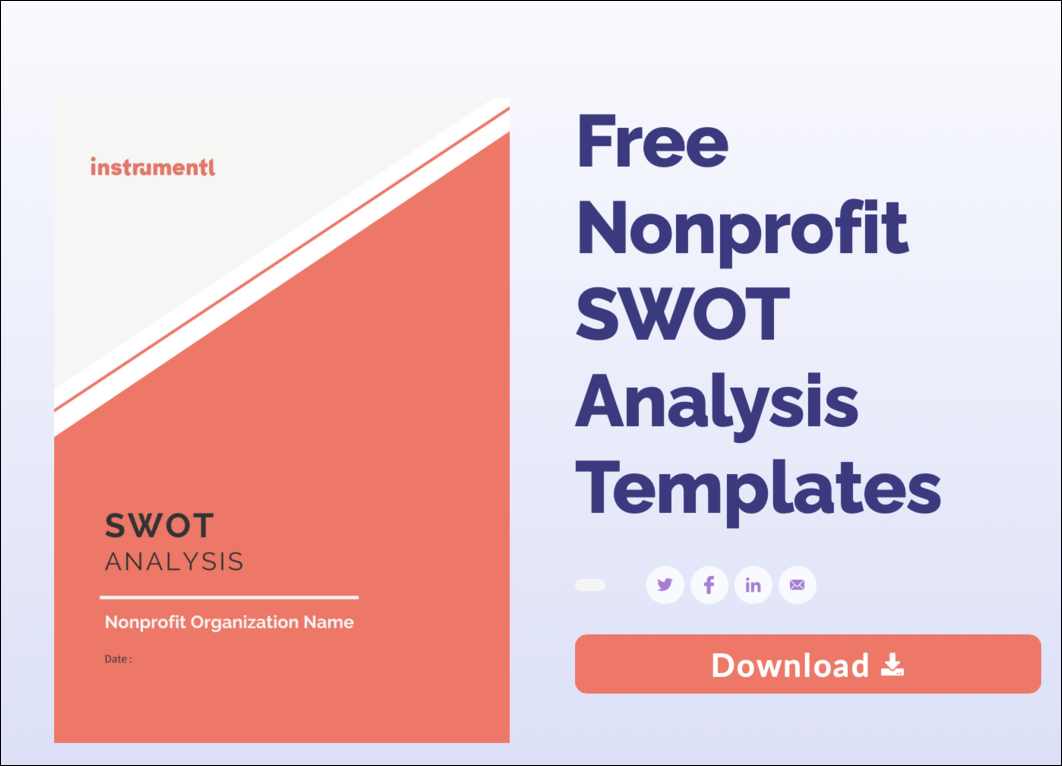
At Instrumentl, we’ve created a free SWOT analysis template that can guide you through your first analysis. As you become more familiar with the process, you should be able to customize this template to your preferences and specific needs.
Wrapping Up: The Next Steps
By conducting a SWOT analysis regularly as part of strategic planning efforts, your nonprofit can gain valuable insights and make informed decisions about resource allocation and program development.
This guide hopefully provided you with some practical takeaways of how to conduct your own SWOT analysis and analyze its findings. Once you’ve identified your organization's unique strengths, weaknesses, opportunities, and threats, don’t forget to check out this guide to driving nonprofit growth through effective development strategies.
Table of contents

