

June 5, 2026
The Impact Issue #114: The Visibility Gap That's Keeping Grant Pros Out Of The Strategy Room
Strategic grant leadership, funding visibility, expert insights & upcoming events — all in one place. (Shadow Work Series, 5 of 6)
Hi! Welcome to The Impact.
We're five weeks into our series on the shadow work economy. If you've been following along, you've seen a clear pattern emerge: Grant pros are spending an inordinate amount of their time being the connective tissue between systems that were never built to talk to each other.
This week we're stepping back from the operational chaos to look at what's actually at stake when data stays siloed across the grants lifecycle.
The funding landscape has never demanded more from grant pros — federal priorities are shifting, private funders are increasingly selective, and the competition for what remains is fiercer than ever.
Grant pros are being asked to make higher-stakes calls about where to invest their time and what to walk away from, often without the full picture to make those calls confidently.
This week: we’re talking about what is made possible when grant pros can finally see the full picture of their funding strategy.
Don’t Miss Out!
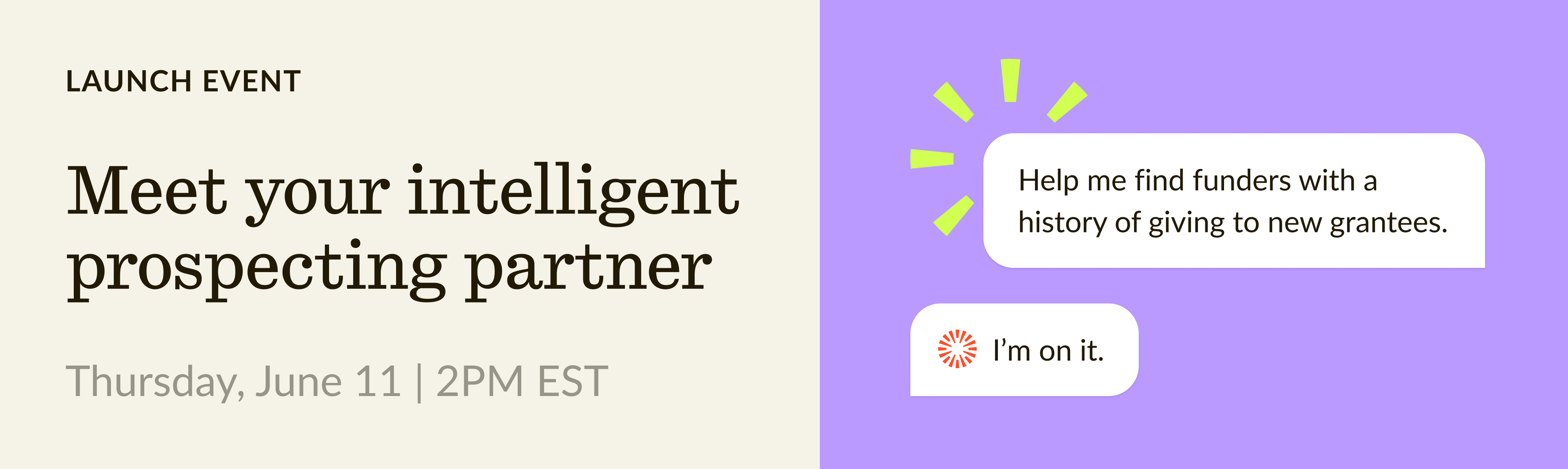
In 2015, we built grant matching because grant professionals needed more than a search tool. Eleven years later, a match isn't enough.
A grant team's job isn't solely to find opportunities. Grant professionals build a strategy: understanding the funding landscape, deciding where to invest your time, and knowing what to walk away from. That takes a prospecting tool that operates as a strategic partner. One that leaves no stone unturned, acts intelligently on your behalf, and finds new opportunities while you sleep.
On June 11th, we're launching exactly that.
Spend an hour with Co-founders Gauri Manglik and Angela Braren and you'll leave with:
- A new way to surface strong opportunities, in less time. Describe what you're looking for in plain language, and let the right grants come to you.
- First access to our new free course on AI for grant professionals, built to GPCI and CFRE standards, with a peer community learning alongside you.
- An early look at where Instrumentl's grant operating system is headed next, including an always-current view of your entire portfolio with the day's urgent work waiting at the top.
Save your spot now. It's free!
Pitfalls and Pointers
Grant pros are asked to hold a lot. Not just the grant pipeline, but a deep understanding of the organization itself: which programs are fully funded, which are at risk, and where the gaps are.
Given that picture, they need to be able to quickly make decisions around which opportunities are worth pursuing, anticipate shifts in the funding landscape before they become crises, and make the case to leadership with data to back it up.
That's a lot to carry. And it's even harder to do well when the data you need to do it is scattered across systems that don't talk to each other.
When grants data lives in disconnected systems across the lifecycle — funder research in one place, application history in another, post-award tracking somewhere else entirely — the full picture of your funding strategy never exists in one place.
Grant pros are the ones stitching it together manually and making consequential decisions about where to invest their time and capacity based on a picture that's always incomplete or a step behind.
In a stable funding landscape, it’s inefficient. In this one, it's costly.
⚠️ Pitfall: The system gap is keeping grant pros out of the strategy room
65% of grant pros say they spend as much time managing grant processes as doing strategic work. That's not a time management problem — it's a systems problem.
Grant pros have the organizational knowledge, the funder relationships, and the program context to be one of the most strategic voices at the table.
- Without a connected view of funder history, program needs, and pipeline status, the strategic inputs a grant pro could offer stay buried under coordination work.
- The signals that should inform funding strategy — a funder shifting priorities, a program at risk, a gap in the pipeline — surface too late to act on, because they're living in systems that don't talk to each other.
- Leadership can't see the full funding picture when the grant pro is manually pulling it all together. And the grant pro can't show up as a strategic partner because they're too busy being the connective tissue.
The infrastructure gap isn't just an operational problem.
Every hour spent reconstructing data is an hour not spent shaping strategy, stewarding relationships, or anticipating funding gaps before they become a crisis.
💡 Pointer: Build the visibility that makes strategic leadership possible
When asked what they'd do with reclaimed time, 51% of grant pros said they'd build stronger funder relationships. 35% said they'd focus on strategic planning. 33% said they'd pursue larger, more complex grants.
The work grant pros actually want to be doing (and that their organizations need them to do) is strategic. The path there starts with visibility.
The best time to set up your post-award infrastructure is before you need it. Here's where to start:
- Map where your grants data lives across the full lifecycle: prospecting, applications, awards, and post-award reporting. Where are the gaps? Where are you the only one who can see the full picture?
- Push for a system where funder history, pipeline status, and program funding needs live in one, connected workspace — so you're analyzing the picture, not assembling it.
- View prospecting as an ongoing strategic posture, not a periodic task. The goal isn't to run a search when you need funding — it's to maintain a clear, current picture of the funding landscape so you can make confident calls about where to invest your organization's time and which opportunities are actually worth pursuing.
- Use that unified view to have different conversations with leadership. Not just a pipeline conversation: "Here's what we applied for.” Be empowered to tell the bigger, more strategic story: "Here's where our funding is at risk, here's what we're doing about it, and here's where I plan to invest my time accordingly."
When the infrastructure catches up to the role, the grant pro stops over-indexing on being the connective tissue and starts being the strategist their organization actually needs.
Expert Perspectives
🏆 Shavonn Richardson and Fielding Jezreel on what it looks like when grant pros step into a more strategic role
The data tells us grant pros are stretched thin and operating without the visibility they need. But experienced practitioners say something else is also true: the profession itself is in the middle of a meaningful shift — and the grant pros who are thriving are the ones who are defining their role differently.
Shavonn Richardson, MBA, GPC, of Think and Ink Grant Consulting, has spent years intentionally repositioning what it means to do this work:
"It took us ten years of intentional positioning to get here — defining ourselves as strategic consultants, not administrative workers. We set clear boundaries from the start: if you want the best outcome, we need to be involved in program design, not just handed a form at the last minute. That shift doesn't happen overnight, but it starts with how you define your own role."
This positioning didn't happen by accident. It came from being clear about where grant expertise actually adds value, and refusing to let the administrative work crowd it out.
Fielding Jezreel, Grant Consultant and Strategist at Jezreel Consulting, sees the same shift happening across the profession:
"It's only been in the last couple of years that I've heard grant writers consistently say, 'I'm doing strategy.' That's a real shift — redefining the work from grant writer to grant professional."
The infrastructure gap we've been talking about all series is real. But so is this: the grant pros who are stepping into a more strategic role aren't waiting for permission.
They're defining what the role demands, and making the case for the systems and support to do it well.
Networking Nook
💻 Webinar: How to Write Proposals That Win
Thursday June 4, 2026 | 7:00 PM ET | Free | Think and Ink Grant Consulting
You know how to write. But writing and winning are two different things.
In this free webinar, Shavonn Richardson of Think and Ink Grant Consulting shares the framework her firm uses to build proposals that actually get awarded.
You'll walk away knowing exactly what to fix in your very next submission.
To check out more recent and upcoming live events, go here.
Ready to Stop Guessing?
….and start making smarter, more strategic funding decisions? With Instrumentl, you’ll get access to real-time funding opportunities, expert insights, and the tools you need to build a more sustainable grant strategy.
Sign up to get The Impact newsletter delivered to your inbox every week. Subscribe now!
100% Free Grant Writing Resources Straight to Your Inbox
