

September 2, 2026
The Impact Issue #123: Why “under budget” can be bad news
Hi! Welcome to The Impact.
Here’s a scene that plays out at grant closeout often: a grant sits comfortably “under budget” all year, everyone feels good about it, and then the final weeks arrive with a chunk of the funds still unspent and almost no time to use them.
Under budget sounds like good news. Sometimes it’s the opposite.
Looking at a grant's budget vs versus actuals tells you whether you’re within your total, but it doesn't tell you whether you’re on pace to actually use the money by the grant’s end date. That gap is where post-award trouble can hide.
Underspend and you may return funds or dent your renewal odds. Overspend and you’re covering the difference with unrestricted dollars.
Confidently keeping a grant on track relies on grants, finance, and program teams working from the same picture.
Today we’re breaking down how to manage the spenddown, not just the spending.
Don't miss out!
Ask Claude or ChatGPT about your grant pipeline today, and you’ll get an answer delivered with total confidence, built on a stale spreadsheet and half the picture.
Connecting Instrumentl to your AI tools changes that. With Instrumentl's Claude connector, your AI works from your live data instead: vetted matches, active pipeline, deadlines, and grant budgets, with every update landing back in your account.
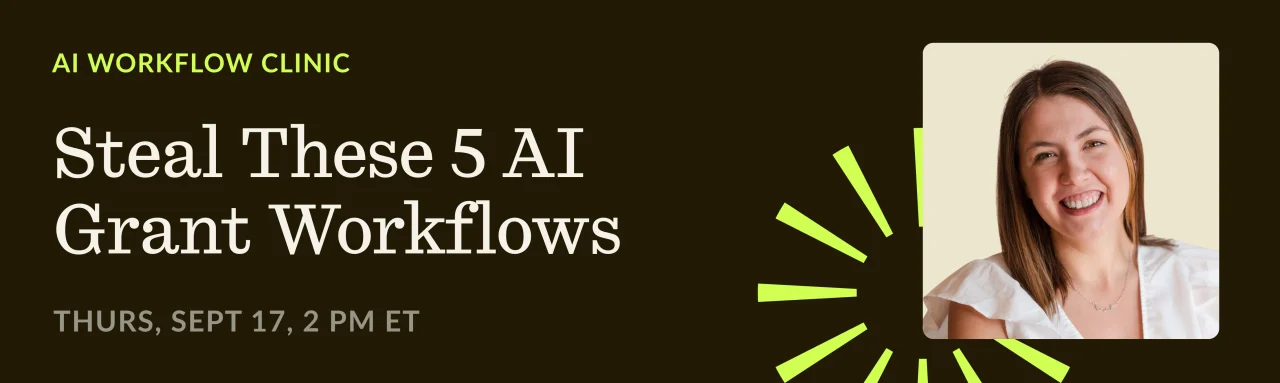
On Thursday, September 17th at 2 PM ET, join Angela Braren, Instrumentl Co-founder, and Katie Castillo, Product Marketing Manager at Instrumentl, to walk through five real AI workflows Instrumentl users rely on. Five demos, five minutes each.
You'll walk away knowing:
- How to set up the connector start to finish: what it can read and update, and how to schedule a workflow so it runs weekly without you asking.
- The exact prompt behind every workflow shown, ready to copy and run the same day.
- Which piece of your week to hand off first, after seeing real pipeline checks, deadline scans, and budget reviews.
Whether you’re already using Instrumentl or just getting started, this one is worth 60 minutes. Join live for your chance to win a full year of the AI tool of your choice, on us.
👉 Save your spot now - it's free!
Pitfalls and Pointers
When it comes to spending down grants, staying under budget isn’t the goal. Using the funds well, on time, and on the record is.
⚠️ Pitfall: Tracking budget vs. actuals, but not pace
A grant's budget versus actuals answers one question, are we within our total? It quietly hides the one that matters just as much: are we on track to spend these funds by the end date?
- Underspending risks returned funds and weaker confidence at renewal. If news of an "under budget" grant only surfaces at closeout, there’s little time left to adjust, make eligible purchases, or request an extension. The cost is real: returned funds, and weaker confidence at renewal.
- Overspending risks covering the gap with unrestricted dollars it didn't plan to spend.
- Stale numbers make it worse. When grant spend is reconciled manually or reviewed only occasionally, program teams make decisions work from guesstimates, and coding or allocation errors often aren’t caught until reporting, when they’re hardest to fix.
Grants are one of the most impactful ways to broaden your funding mix, but only if grant-seeking is a resourced capability, not a task that lives or dies with one person.
💡Pointer: Measure spend against time, on a regular cadence
The fix isn’t more spreadsheets. It’s measuring the right thing, often enough, with the right people in the room.
- Measure spend against time, not just budget. At every checkpoint, ask whether spending is on pace for where you are in the grant period, not merely whether you’re under the total. A large gap from that pace, in either direction, is your cue to investigate.
- Put it on a recurring cadence. Monthly where you can, or at minimum a scheduled grant-by-grant check-in. The whole point is to catch drift while there’s still time to adjust, reallocate, or pursue an amendment.
- Get finance, grants, and program teams in the room together. Spend data, upcoming needs, coding questions, and funder restrictions all resolve faster when the people who hold each piece review together, ahead of reporting time.
- Track what’s committed, not just what’s booked. Planned and committed expenses alongside booked ones show the full expected spend picture, so “on pace” reflects reality rather than just what’s cleared so far.
The teams that do this well aren’t spending faster. They’re spending intentionally, across the whole period, with no surprises waiting at closeout.
Expert Perspectives
🏆 Tosha Anderson on the One Comparison to Run Every Month
At our recent Grant Strategy Summit, Tosha Anderson, founder and CEO of The Charity CFO, named this exact blind spot that lets grants drift: only keeping an eye on budget versus actuals without pacing.
She advises nonprofits to look at spending and time has elapsed in the grant period, and ask whether your spend matches your pace.
A 12-month grant should be spending roughly one-twelfth of its budget each month. If your actual spend is way off that pace, in either direction, that’s the alarm, long before closeout, when you can still do something about it.
Neither ending is good news: unspent funds get returned (and quietly signal you couldn't absorb the capacity), while overspending leaves your organization covering costs the grant won't.
The trap is that neither shows up on a simple budget-vs-actuals view until it’s often too late to fix.
“Both of them are kind of invisible sometimes until that program or project closeout. Here’s the one comparison to run every single month: not only your budget to actual, but how much time has elapsed within that project period.” — Tosha Anderson, Founder & CEO, The Charity CFO
👉 Watch Tosha’s full session from Instrumentl's Grant Strategy Summit last week
Open Grant Opportunities Spotlight
NBA Foundation Grants (National Basketball Association Foundation)
Grant Amount: More than $25,000 (median grant is $150,000)
Next Deadline: October 31, 2026
Who It's For: 501(c)(3) nonprofits (or Canadian T3010 orgs) serving under-resourced youth ages 14–24, operating in a market with an NBA team
The Details:
- Funds workforce development and career-readiness programs that support the school-to-career transition: job readiness, skill training, job placement, and career advancement
- Requires serving a minimum of 25 youth annually; priority goes to organizations in NBA team markets (28 markets across the U.S. and Canada)
- Supports projects and programs (not facilities or capital projects)
- Single-year funding only
What their past giving tells us:
- 50-60 grants awarded annually with giving concentrated in Tennessee but reaching most states
- 50% of awards went to new grantees over the most recent three years
Laird Norton Family Foundation Grant (Laird Norton Family Foundation)
Grant Amount: Unspecified amount (median grant is $10,000)
Next Deadline: Rolling
Who It's For: U.S. nonprofits, with preference for California, Oregon, and Washington
The Details:
- Funds four program areas reflecting the family's values: arts in education, climate change, human services, and watershed stewardship
- Supports education/outreach and general operating expenses
- Funds four program areas reflecting the family's values: Arts in Education (arts-integrated instruction in public Pre-K–12), Climate Change (carbon sequestration on the West Coast), Human Services (youth homelessness prevention in King County, WA), and Watershed Stewardship (Minnesota, Wisconsin, and key Western watersheds)
What their past giving tells us:
- Median grant size has increased over the past few years, with $1.65 million in total giving over the last two years
- 31% of awards went to new grantees, and giving prioritizes environment, arts and culture, and human services organizations
Ready to find more good-fit opportunities? Explore 35,000+ active grant opportunities now!
Networking Nook
💻 Activate: The Fundraising Readiness Summit
September 8, 2026 | Virtual | Free
A free, sector-wide virtual learning summit built around one idea: the most powerful fundraising tool in 2026 is you.
Instead of sorting sessions by job title, Activate is organized into three tracks, Confidence, Skills, and Muscle Memory, plus a Partner Showcase of 10-minute talks of practical expertise.
Free, virtual, and built for the whole sector, you’ll leave with something you can actually put into practice immediately.
To check out more recent and upcoming live events, go here.
See your spenddown for every grant, in one place
The whole problem with budget-vs-actuals is that the numbers live in your accounting system, and getting them into a view where you can actually track pace usually means someone exporting, re-keying, and reconciling by hand. By the time it’s current, it’s often too late to act.
Instrumentl’s Spenddown syncs grant expense data directly from your accounting system, which stays your source of truth, so your budgets and actuals stay current without the manual work.
From there, you can see where spending stands against where you are in the grant period, not just against the total, and catch a grant drifting off pace while there’s still time to adjust, reallocate, or request an extension.
👉 See what Instrumentl can do for your team
Sign up to get The Impact newsletter delivered to your inbox every week. Subscribe now!
100% Free Grant Writing Resources Straight to Your Inbox
